
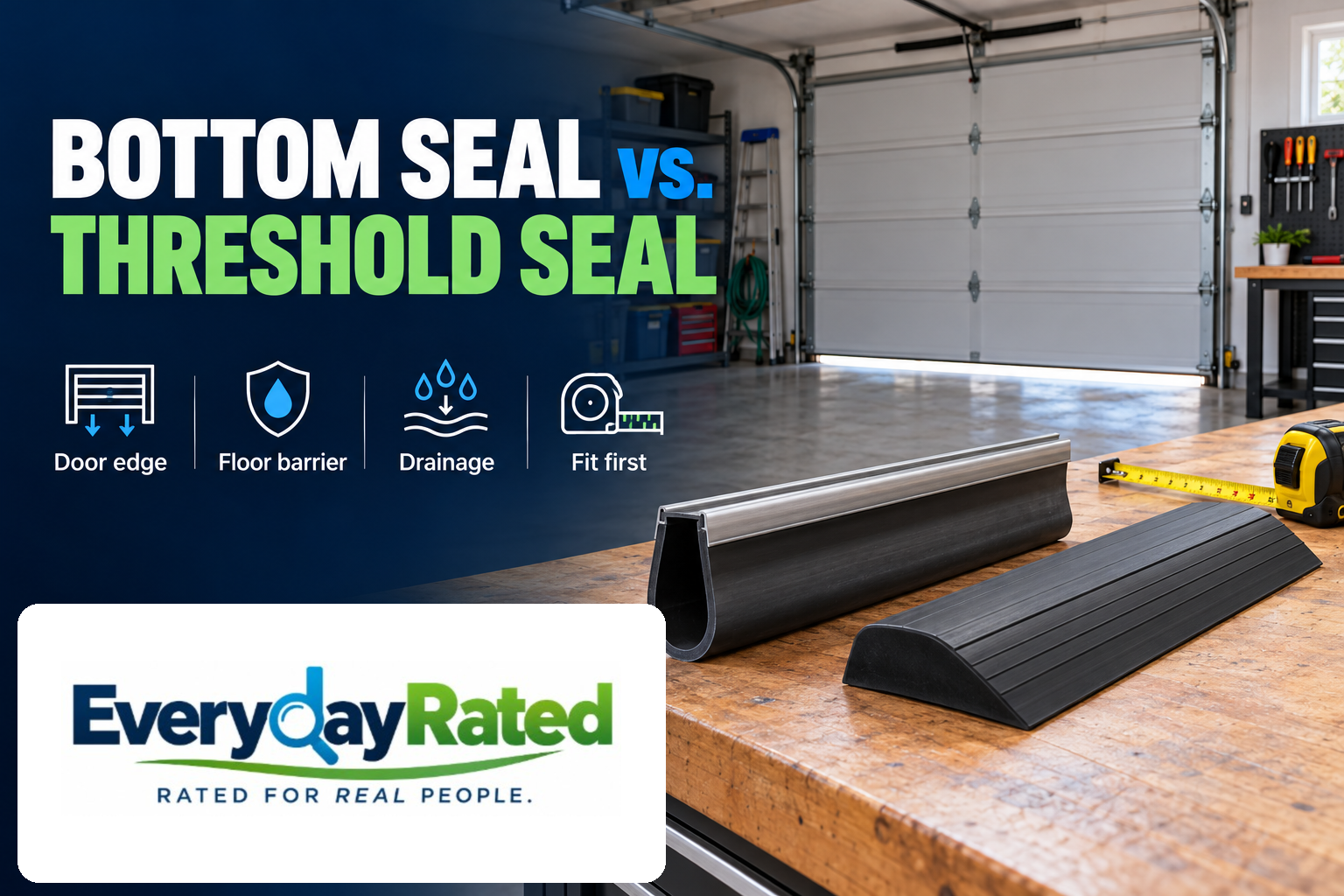
The garage door bottom seal vs. threshold decision sounds like a head-to-head match. In practice, the two can be teammates. One rides on the door; the other stays on the floor. Choosing correctly starts with the gap or water route you need to address, rather than whichever listing promises the most dramatic weatherproofing.
Disclosure
Affiliate disclosure: EverydayRated may earn a commission from qualifying purchases, at no additional cost to you. Our recommendations are based on independent research and product specifications. Affiliate relationships do not determine our rankings.
Quick Answer
Choose a compatible bottom seal to replace a worn strip on the door. Consider a floor threshold for a suitable remaining floor-line gap or water-entry route after checking drainage and door operation. Some installations use both; neither is a repair for damaged door hardware or a guarantee against flooding.
Bottom seal
Best starting point when the existing door-mounted strip has failed.
Threshold seal
Consider when a floor-mounted barrier addresses the identified route.
Both or neither
Compatibility, drainage and door condition decide—not bundle pricing.
How We Evaluated
Last Reviewed: October 22, 2026. We compared the functions and installation requirements described by Clopay, GaraDry and Sealeze, with DASMA guidance for door-system safety. These are category-level recommendations, not independently measured product rankings. Manufacturer performance descriptions are treated as claims rather than proof of flood protection.
At a Glance: What Changes When You Choose Each?
| Factor | Bottom seal | Floor threshold |
|---|---|---|
| Mounting location | On the moving door’s bottom edge | On the garage floor at the opening |
| Buying match | Door/retainer profile and dimensions | Opening, gap, floor and crossing traffic |
| Common reason to consider | Existing strip is worn or damaged | A suitable floor-line barrier is needed |
| Installation constraint | Safe access and model-specific fitting | Surface preparation, bonding and cure |
| Everyday tradeoff | A wear part that must fit its holder | A permanent raised edge across the entrance |
Bottom seal: repair the part the door was designed to use
The bottom seal compresses at the closing edge. Clopay describes several attachment profiles and separates these from seals around the frame. Check the exact profile and size before ordering; “garage door seal” is a category label, not a fit guarantee. (Clopay)
Our category verdict is to start here if the original bottom strip is visibly failing and the door otherwise closes properly. Replacing the failed part gives you a clear repair to evaluate before adding another component. That is a sequence recommendation, not a claim that every replacement strip will outperform every threshold.
Ask the supplier to confirm fit using the door model and an accessible photograph of the old profile. Also ask what the replacement procedure involves. A low material price loses its appeal if the job needs specialist access you had not included in the budget.
Skip a seal-only shopping trip when the door has a major uneven gap, damaged retainers or a change in travel. The question then becomes why the door does not meet the floor correctly. A flexible strip deserves a reasonable job description; rebuilding the geometry of your garage is asking a lot.
Threshold seal: add a floor barrier for a defined reason
A threshold adds a raised profile across the opening. GaraDry’s guidance distinguishes water entering under the door from slush dripping off a parked vehicle, and calls for drainage assessment where water pools outside. Its products do not solve every route through a wall or slab. (GaraDry USA)
Consider a threshold when the door and floor measurements support it, the surface is suitable, and its position will not interfere with operation. Look at the end details too. A neat strip across the middle does little for a route left open around its ends.
The tradeoff is daily crossing. Think about shoes, mobility needs, bicycles, carts and wheeled equipment. Ask for the profile dimensions rather than judging the ramp from a flattering product photograph. A barrier you must cross several times a day deserves more thought than a checkout add-on.
Buy for the identified problem. If the only puddle is beneath a snow-covered vehicle, investigate that source before installing a barrier at the door. If runoff is already collecting outside, obtain drainage advice instead of treating a taller profile as the entire plan.
Can you use a bottom seal and threshold together?
Potentially, but confirm the combination with the door and threshold suppliers. Dry fitting is especially useful before committing adhesive. The finished system needs to close, lock where applicable, and operate normally without interference.
GaraDry specifically instructs installers to check closing, locking and motor operation with its threshold positioned before bonding. The same instructions list surface preparation requirements and a 24-hour wait before driving over the installation. (GaraDry USA)
Do not assume installation rules transfer between brands. For example, Sealeze’s published threshold guide excludes painted or treated surfaces and calls for temperatures above 40°F. GaraDry gives its own surface instructions. Choose a system appropriate to your floor instead of borrowing the convenient half of each manual. (Sealeze)
Garage door bottom seal vs. threshold: compare total repair cost
Write down the exact length, matching accessories, adhesive, surface preparation materials, shipping and installation labor. Check whether adhesive is included and whether your vehicle can remain out of the garage during curing. Those details determine the actual project cost.
For a bottom seal, establish whether the retainer can accept the new part and whether access is straightforward under the approved procedure. For a threshold, establish whether the floor needs repair or coating preparation first. We have not published a universal price range because neither the door nor the floor is a universal size.
Request an itemized quote if a professional is involved. Separate the price of restoring the original door seal from adding a threshold or repairing drainage. You can then decide which work is necessary and which is optional, rather than approving one mysterious “weatherproofing package.”
Four buying questions worth asking out loud
What has actually failed? Ask whether the observed gap comes from a worn part, the slab profile or door operation. Get photographs or an explanation you can understand.
What must fit? Have the seller identify the required dimensions and interfaces. A return policy is helpful, but it is a poor substitute for measuring.
Where does the water go? Plan the route on both sides of any barrier. Clearing snow from the approach is a separate task; our snow shovel buying guide explains the tool choices for that job.
Does the door still work correctly? Never loosen bottom brackets or spring-connected hardware to make a weather seal fit. DASMA reserves those adjustments for trained technicians. (DASMA)
Who should skip buying either one today?
Skip the purchase if you have not identified a gap, a failed part or a water-entry route that the product can address. Also pause if the door has an operational fault or the floor needs a wider repair. An accurate diagnosis is allowed to end with “nothing to order yet.”
For other workshop and vehicle decisions, see our Garage & Auto guides. This garage door bottom seal vs. threshold comparison does not nominate a branded winner: there is no common independent test here establishing one seal product as best for every opening.
EverydayRated Verdict
Rated Head-to-Head: a compatible bottom seal is the first choice for a failed door-mounted strip. A threshold is a separate floor-barrier decision that depends on fit, water routing and everyday access. Use both only when the combination addresses a real need and preserves correct door operation.
Sources & Research
Sources reviewed October 22, 2026. Manufacturer guidance establishes product functions and installation conditions; it is not independent comparative testing.