
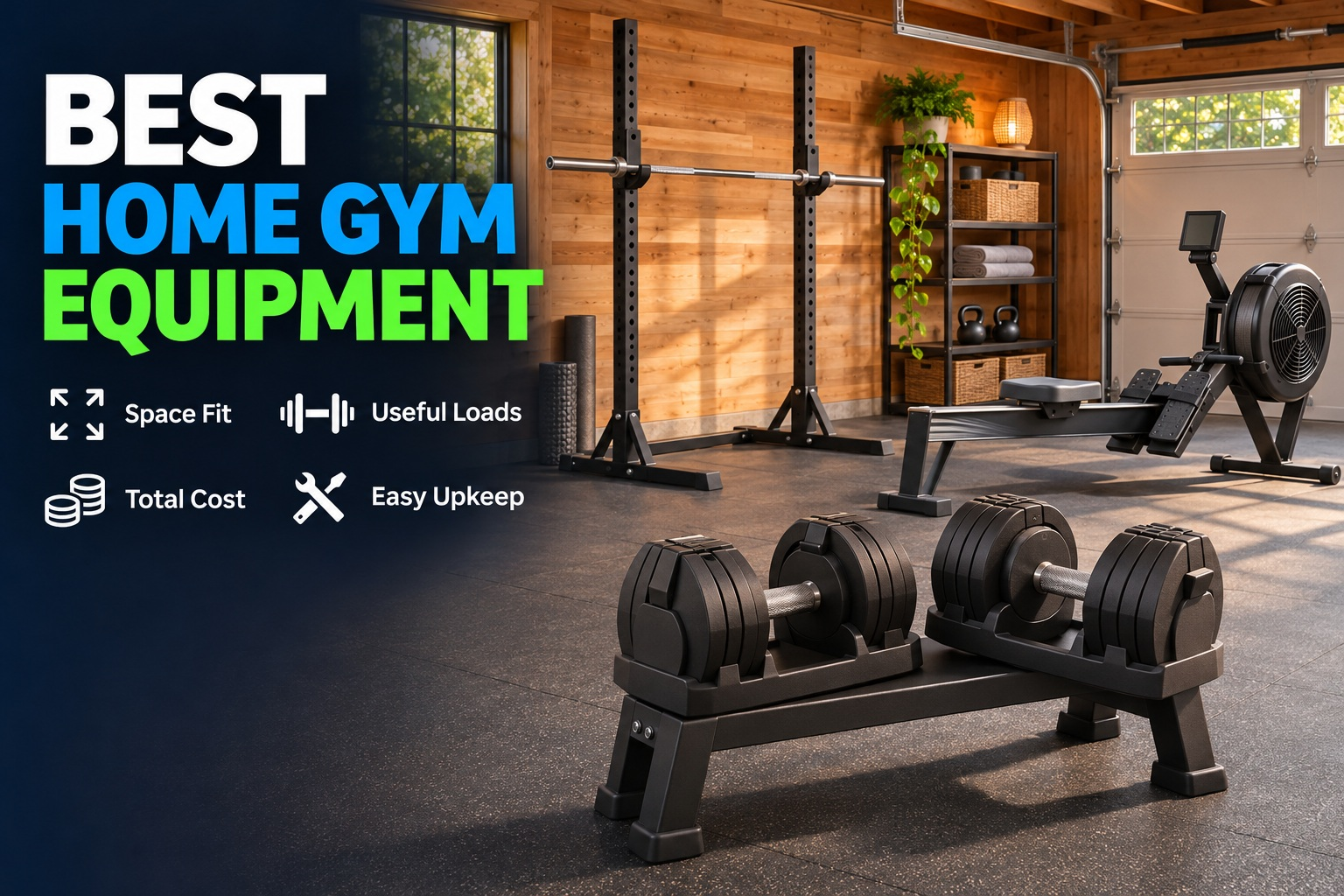
The best home gym equipment earns its floor space. For a general strength-focused start in 2026, our Best Overall Starter Purchase is the REP QuickDraw 50 lb pair. Choose the Rogue SML-2 for a barbell-centered setup, or add the Concept2 RowErg when rowing is the cardio you will actually do.
This is a three-part equipment shortlist for U.S. home buyers, rather than a contest between interchangeable machines. You do not need to buy all three. We compare practical uses, working space, current purchase costs and ownership trade-offs, so a spare room can keep its day job until you are ready to commit.
Affiliate disclosure: EverydayRated may earn a commission from qualifying purchases, at no additional cost to you. Our recommendations are based on independent research and product specifications. Affiliate relationships do not determine our rankings.
Quick Answer
Start with the activity you want to repeat. Dumbbells suit a flexible strength setup; a squat stand supports a more committed barbell plan; a rower adds a dedicated cardio option. Keep your first purchase focused on one clear need.
REP QuickDraw 50 lb Pair
4.5 / 5
General strength training in a shared room
$495.99 per pair
Rogue SML-2
4.3 / 5
Lifters building around a barbell and plates
$525 stand; $720 with listed spotter arms
Concept2 RowErg
4.5 / 5
People who enjoy rowing and want self-directed cardio
$990 plus applicable shipping and tax
How We Evaluated Home Gym Equipment
Last Reviewed: November 9, 2026. These are EverydayRated research-based editorial assessments. We have not physically tested these products. Current U.S. manufacturer pages govern configurations and quoted prices; original hands-on reviews inform usability and limitations.
We used one rubric: usefulness for the intended home-training role (30%), ease of use and evidence quality (25%), space and storage demands (20%), complete ownership value (15%), and documented support and maintenance (10%). Scores are editorial judgments, not laboratory results or a numerical average of retailer stars. The awards identify different needs; the rower and dumbbells are not substitutes.
We considered fixed dumbbells and heavier adjustable systems, full racks instead of stands, and quieter or screen-led cardio formats. This shortlist favors a manageable strength starting point, a deliberate barbell foundation and a cardio addition without a compulsory class fee. Buyers needing heavy dumbbells, enclosed rack safeties or near-silent cardio should shop beyond these three.
There are no comparable long-term failure-rate data in our reviewed sources. Manufacturer impact claims are not independent durability proof, and older reviews do not establish current prices. Prices can change; dispatch statements are not delivery guarantees. Generated artwork illustrates equipment categories and does not show exact recommended models.
At a Glance
| Equipment | Score / role | Checked cost | Main limitation |
|---|---|---|---|
| REP QuickDraw 50 lb Pair | 4.5/5 — Best Overall Starter Purchase | $495.99 per pair | 50 lb supplied; 60 lb system ceiling |
| Rogue SML-2 | 4.3/5 — Best for Barbell Training | $525 stand; $720 with listed spotter arms | Add bar, plates and other essentials |
| Concept2 RowErg | 4.5/5 — Best Cardio Addition | $990 plus applicable shipping and tax | Noise and a long operating area |
Purchase links lead to ordinary manufacturer stores. No affiliate tracking links were supplied. Figures are U.S. dollars; tax, shipping and selected accessories can change the checkout total.
1. REP QuickDraw Adjustable Dumbbells — 50 lb Pair
EverydayRated Score: 4.5 / 5
Key Specifications: 5–50 lb per hand in this variant; switch adjustment; optional add-on plates up to 60 lb per hand
For a general-purpose home gym, we would start with adjustable dumbbells before committing a room to a larger machine. They let a beginner choose different loads for different movements, while leaving the rest of the room available after training. Our preferred starting purchase is the QuickDraw 50 lb pair, provided that load range fits the buyer’s planned exercises.
REP’s selected U.S. listing showed $495.99 for the 50 lb pair, with shipping included and a stated 24–48-hour dispatch window. The range starts at 5 lb per hand; compatible add-on plates can raise this pair to the system’s 60 lb maximum. Normal balanced jumps are 5 lb. A single 2.5 lb microplate permits a smaller step with some imbalance. Check the selected size before payment. [1]
Garage Gym Lab’s hands-on review found the switch adjustment fast and the design approachable, but criticized the maximum load and overall length. Its drop testing provides useful evidence of impact tolerance in those samples. That evidence is stronger than a specification alone, but it cannot predict every unit’s service life or make deliberate dropping a sensible routine. [2]
Load range and everyday handling
The buying implication is straightforward: choose these if switching between moderate loads matters more than eventually lifting very heavy dumbbells. Someone already close to 50 lb on important movements should compare a heavier system before paying for an upgrade path that stops at 60 lb. A long dumbbell can also feel awkward on close-together movements; trying a similar shape in person is worthwhile.
REP states a lifetime defect warranty for the original purchaser, with exclusions including normal wear and abusive use. It is not blanket accidental-damage insurance. Keep the receipt, follow the loading instructions, and check plate engagement before lifting. The cradles need a stable home, and floor space for exercising remains necessary even when storage is compact. [1]
We assign 4.5/5 for a useful strength-training starting point with convenient adjustment and published hands-on evidence. The limited expansion ceiling and shape trade-offs prevent a higher score. You can begin with suitable standing or floor-based movements; add a bench only when your routine needs one. Buying every accessory on day one is an expensive way to discover what you actually enjoy.
Pros
- Several useful loads in one stored pair
- Fast switch adjustment supported by hands-on review
- Expandable from this variant to 60 lb per hand
Considerations
- 60 lb ceiling can limit future progression
- Longer shape may interfere with some movements
- Warranty exclusions still apply to misuse and wear
Why We Picked It
The most flexible first purchase for a general strength-focused room; its score reflects convenience and useful evidence, with limits for load growth and size.
2. Rogue SML-2 90-inch Monster Lite Squat Stand
EverydayRated Score: 4.3 / 5
Key Specifications: 49 × 48 in base footprint; 92.25 in overall height; 157 lb; 3 × 3 in 11-gauge uprights; 5/8 in holes
The SML-2 is the specialist choice for a room organized around barbell training. Choose it because you want a rack-based routine, rather than because the steel looks impressive in a garage photo. A stand without a bar and plates is furniture with ambition, and the accessories belong in the budget from the beginning.
Rogue lists the stand at $525 and compatible SAML-24 spotter arms at $195, making that combination $720 before tax and shipping. A barbell, plates, collars, bench and floor protection are separate purchases. The listing includes J-cups and a pull-up bar; do not confuse J-cups, which hold the bar before a lift, with spotter arms intended to catch it. [3]
Measure the actual 92.25-inch overall height rather than assuming the “90-inch” name is the installed ceiling requirement. Its 49-by-48-inch base also excludes the working space around a loaded bar. Leave room to load plates, move safely and perform intended movements without striking a ceiling, light or garage-door track. A footprint rectangle on a floor plan is only the start. [3]
Barbell equipment compatibility and ownership
The 3-by-3-inch uprights and 5/8-inch holes place it in Rogue’s Monster Lite accessory family. Verify each attachment explicitly; similar-looking tubing does not establish universal compatibility. Rogue’s warranty table lists limited lifetime coverage for structural welds. That is a specific coverage category, not a promise that every accessory or cosmetic finish has lifetime coverage. [3] [4]
Garage-Gyms’ rack guide highlights an important counterpoint: a squat stand does not automatically take less room than a full rack. Its historical comparison shows why base dimensions and attachment options matter more than the label. Those older prices are not our current buying figures, and the guide does not provide a controlled modern stability test of every configuration. [5]
Our 4.3/5 recognizes a documented, adaptable barbell foundation, while deducting for the substantial completion cost and more specialized role. We did not establish a comparative failure rate. Before buying, compare a complete compatible full-rack setup at the delivered price. Follow Rogue’s assembly, stability and permitted-use instructions; a rated capacity alone does not validate every lift or attachment arrangement.
Pros
- Clear specifications and established accessory family
- J-cups and pull-up bar included
- Suitable foundation for a deliberate barbell setup
Considerations
- Spotter arms and training equipment increase total cost
- Installed height exceeds the nominal 90-inch name
- Open stand requires careful safety and space planning
Why We Picked It
A focused barbell purchase with transparent expansion choices. The 4.3 score accounts for the cost and space of completing the setup.
3. Concept2 RowErg — Standard Legs with PM5
EverydayRated Score: 4.5 / 5
Key Specifications: 96 × 24 in assembled; 9 × 4 ft recommended use area; 14 in seat; 57 lb; PM5 monitor; separates for storage
The RowErg is our cardio addition for someone who already knows they like rowing. Its appeal is a focused workout machine rather than a large entertainment screen. If you have never rowed, spend time on one at a gym before spending nearly a thousand dollars. A familiar exercise you look forward to is a better starting point than a machine selected by specification sheet.
The standard-leg U.S. RowErg lists at $990 with the PM5 monitor and device holder. It measures 96 by 24 inches assembled, but Concept2 recommends a 9-by-4-foot area with clearance for use. The seat is 14 inches high. The machine separates into two pieces for storage; that is different from folding it while leaving everything connected. [6]
Basic operation does not require a paid membership, and Concept2 provides its free ErgData app for workout logging and additional features. Other compatible apps can carry their own charges. Decide whether you want a straightforward data display or an instructor-led experience, then price that experience separately rather than assuming every rower includes the same software. [6]
Rower noise and maintenance
Expert Reviews’ hands-on review found noise a meaningful drawback, pointing to the fan, moving chain and sliding seat. We would treat that as a real apartment-buying issue, without turning one reviewer’s experience into an exact sound level for your room. Ask household members to listen while you try a similar air rower; a quiet conversation beside it is a useful practical check. [9]
Concept2 specifies two-year coverage for moving parts and the monitor, and five years for frame parts. Its maintenance schedule includes chain oiling every 50 hours of home use. These are concrete ownership obligations, not evidence that a unit will never need repair. Before purchase, identify a place to clean it, store the separated sections and access the maintenance instructions. [7] [8]
Our 4.5/5 reflects a useful self-directed cardio setup, documented service support and no compulsory class subscription. Noise, operating length and the need to enjoy the rowing motion limit its audience. It ties the dumbbells on editorial score for its intended role; the dumbbells retain the overall starter award because this guide prioritizes a flexible general strength purchase.
Pros
- PM5 and device holder included
- Free ErgData option without compulsory class fees
- Documented maintenance and separate frame/parts coverage
Considerations
- Air resistance and moving parts are audible
- Needs a long working area despite separable storage
- Does not replace progressive strength equipment
Why We Picked It
A strong cardio addition for an established rowing preference. The 4.5 score is role-specific, with clear deductions for noise and space.
Home Gym Equipment Buyer’s Guide: Make the Room Work for You
1. Choose a routine before choosing a machine
Write down what you want to do during a normal week. A modest strength setup and a walking route may meet your needs better than an expensive cardio machine. Conversely, a dedicated rower may be worthwhile if that is the exercise you consistently choose. Equipment makes an activity available; it cannot guarantee that you will enjoy it.
For a closer comparison of load formats, read our free weights buying guide. For strength equipment, consider the loads you use today and the likely next step. A maximum weight is a limit, not a recommendation for your starting load. Small, practical weight changes can matter more than an impressive top number. If you are unsure about technique or setup, budget for instruction alongside the equipment.
2. Measure the workout, not just the storage footprint
Mark the proposed layout on the floor with removable tape. Then walk through getting equipment out, changing loads, moving into position and putting everything away. Include doors, furniture, children’s routes and the space needed to load a bar. Storage dimensions do not show whether a workout fits.
Consider ceiling height, floor loading and how noise travels to neighboring rooms. Check building or lease requirements where relevant. A mat can protect a surface, but should not be assumed to make heavy lifting structurally suitable or silence an air rower. For this shortlist, the RowErg’s recommended use area and the SML-2’s actual installed height are more useful planning figures than their product names. [3] [6]
3. Price the complete usable setup
Use a simple worksheet: equipment + required accessories + delivery and tax + suitable flooring + any software you actually want + maintenance. Separate essential purchases from optional storage and appearance upgrades. You can often defer a stand or premium finish; you should not defer the equipment required to use the setup safely.
The SML-2 example shows the difference: $525 plus $195 for the listed spotter arms is $720 before a barbell or a single plate. The QuickDraw price here buys a pair, while some other dumbbell listings quote one unit. Compare the same quantity and load range. For connected equipment, ask what remains usable if you stop paying for classes. [1] [3]
Used equipment can reduce the entry cost, but check model identity, missing parts, condition and recall status. The CPSC recall for older BowFlex 552 and 1090 adjustable dumbbells warns that plates can dislodge and instructs owners of recalled units to stop use and follow the remedy. Do not infer that every newer product with similar branding is covered; use the exact recall identification. [10]
4. Buy for upkeep and the people sharing your home
A setup that stays ready is easier to use than one buried behind storage boxes. Assign cradles, collars, cables and cleaning supplies a home. Keep children and pets away from weights and moving equipment, and follow the exact manufacturer instructions for assembly, plate engagement and storage. Inspect the equipment before use rather than relying on a warranty as a safety check.
For barbell work, plan appropriate compatible safeties and their setup for the intended lifts. A stand’s load rating does not tell you whether your particular arrangement will catch a failed repetition. For a rower, include scheduled cleaning and chain care. For any purchase, retain the serial information, receipt and manual so support remains straightforward. [3] [8]
More equipment only helps when it solves a real limitation. Keep a short list of what your current setup prevents you from doing, then buy the next item for that reason. Your spare room does not need to become a showroom to become useful.
Related Home Fitness Buying Guides
If you want routine weight logging alongside your training records, our smart scales guide explains connected features and the limits of body-composition estimates.
For broader shopping coverage, browse EverydayRated’s Health & Well-Being guides. Choose accessories after your core training space and routine are settled.
EverydayRated Verdict
The REP QuickDraw 50 lb pair is our Best Overall Starter Purchase for a general strength-focused home gym: several useful loads without committing the room to a rack or cardio machine. Skip it if your planned dumbbell work already demands more than the system’s 60 lb ceiling.
Choose the Rogue SML-2 when barbell training drives the plan and you can fund the complete setup. Choose the Concept2 RowErg when you enjoy rowing, have the operating space and can live with its sound. People happy with bodyweight exercise, outdoor activity or an existing gym may not need any of these purchases.
The final test is practical: will the complete setup fit your room, budget and preferred routine? Buy the equipment that answers that question, then let regular use earn the next upgrade.
Sources & Research
- REP QuickDraw 50 lb pair — selected U.S. variant, specifications and warranty
- Garage Gym Lab — original QuickDraw review and drop testing
- Rogue SML-2 — current U.S. price, dimensions and accessories
- Rogue — product warranty terms
- Garage-Gyms — rack and squat-stand design comparison (historical prices)
- Concept2 RowErg — current U.S. product and specifications
- Concept2 — RowErg warranty
- Concept2 — RowErg maintenance schedule
- Expert Reviews — original RowErg review
- CPSC — BowFlex 552 and 1090 adjustable dumbbell recall