
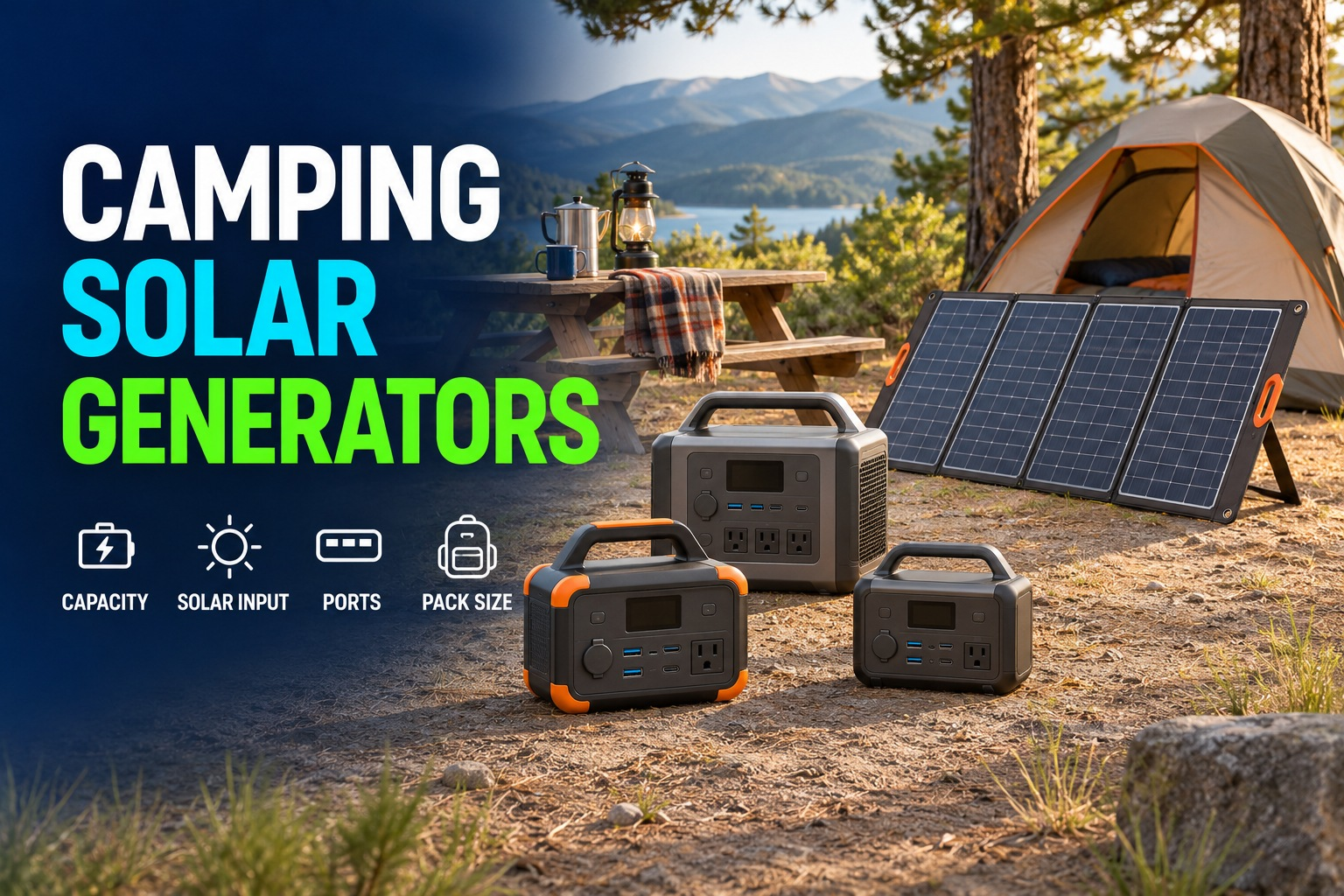
A campsite power station should run your essentials without making the packing list need its own trailer. Among the 2kWh-class systems compared here, our starting pick is the EcoFlow DELTA 2 Max for vehicle-based camping. Consider the Anker SOLIX F2000 when wheels and an integrated RV-style outlet matter more than carrying weight.
Jackery’s current HomePower 2000 Plus v2 is a third option to watch, but its listing showed preorder shipping dates during this review. It is a different product from the original Explorer 2000 Plus previously covered here.
Affiliate disclosure: EverydayRated may earn a commission from qualifying purchases, at no additional cost to you.
Research-based comparison: We reviewed U.S. manufacturer specifications, manuals and package details. We have not physically tested these units or measured runtime, noise, recharge speed or battery longevity. Last reviewed: November 22, 2026.
Quick Answer
- Start with EcoFlow for a carry-style 2,048Wh station with 2,400W rated AC output.
- Choose Anker for rolling transport and its TT-30R outlet, subject to the same 2,400W overall AC limit.
- Consider the Jackery v2 later if its expansion system suits your plans and its shipping date works for your trip.
- Only charging phones and lights? A smaller power station or power bank may be a better buy.
How We Evaluated
We prioritized usable planning information: stored energy, continuous output, transport, solar charging requirements, package contents and expansion compatibility. Our selections are editorial judgments for different use cases. We do not assign numerical scores without comparable test evidence or claim that one brand’s cycle-life estimate proves longer real-world service.
Camping Solar Generators at a Glance
| Model | Published capacity / AC output | Transport or buying detail | Main limitation |
|---|---|---|---|
| EcoFlow DELTA 2 Max | 2,048Wh / 2,400W total | 50 lb; carry-style case | Heavy to lift; base package has no panel |
| Anker SOLIX F2000 / PowerHouse 767 | 2,048Wh / 2,400W total | 67.2 lb; wheels and retractable handle | Wheels do not remove the lifting burden |
| Jackery HomePower 2000 Plus v2 | 2,048Wh / 2,400W | Preorder dates shown at review | Original 2000 Plus expansion battery is incompatible |
Figures are manufacturer ratings. They do not promise that a particular appliance will run or establish delivered AC energy.
1. EcoFlow DELTA 2 Max: Our Starting Pick for Car Camping
EcoFlow combines 2,048Wh of storage with six AC outlets sharing a 2,400W continuous rating. Its two solar inputs support up to 500W each, or 1,000W combined, within their specified voltage and current limits. That makes it a practical candidate for a campsite with several devices and a planned recharge setup.
Why consider it
- Two solar inputs allow a more flexible panel plan.
- Compatible extra batteries can extend storage.
What could change the decision
- The listed 50 lb still has to be lifted into your vehicle.
- A station-only package does not include solar panels.
Our preference is for buyers who need this capacity and can manage the case. Check the full kit price rather than assuming the solar-generator headline includes everything pictured. X-Boost is a separate feature, not the normal continuous-output rating.
Compare EcoFlow Packages2. Anker SOLIX F2000: Best Fit for Rolling Transport
Anker’s manual identifies the F2000 as PowerHouse 767 and specifies 2,048Wh, up to 2,400W total AC output and up to 1,000W solar input. Its wheels and retractable handle are the main reason to put it on this shortlist.
Why consider it
- Rolling transport can suit firm, accessible paths.
- TT-30R outlet provides a convenient connection for compatible RV setups.
What could change the decision
- At a listed 67.2 lb, loading and steps remain important.
- The outlet shape does not supply unrestricted 30-amp RV service; the unit’s total output limit still applies.
Before choosing it, picture the whole route from storage to campsite. A rolling case helps on a path but cannot make a heavy lift disappear. The manual also lists a 32°F minimum charging temperature, which matters on cold-weather trips.
Check Anker Specifications and Manual3. Jackery HomePower 2000 Plus v2: An Expansion Option With a Timing Catch
The current Jackery page lists a 2,048Wh capacity and 2,400W output. At review, it showed a December 14 preorder shipping date, with certain 500 X bundles dated January 1. Confirm the current year, date and selected package directly before placing an order.
This v2 should not inherit specifications from the original Explorer 2000 Plus. Jackery explicitly says the original Battery Pack 2000 Plus is incompatible; the v2 requires Battery Pack 2000 Plus v2.
Why consider it
- Current modular platform with station-only and solar bundles.
- A defined route to additional compatible storage.
What could change the decision
- Preorder timing makes it unsuitable for an immediate-trip recommendation.
- Similar names can hide incompatible accessories and different output ratings.
What a Solar Generator Actually Includes
In this category, a solar generator usually means a battery power station paired with compatible panels. The battery stores energy; the panel replenishes it. A photo of a folding panel does not establish that the selected offer includes one.
Write down the complete shopping list: station, panel wattage and quantity, correct cables, any adapters and any expansion battery. Compare that total with the same components in another offer. A lower station price can become a higher camping-system price.
Plan Runtime Before You Buy
Watt-hours describe stored energy; watts describe power. A 2,048Wh battery divided by a constant 100W load gives a theoretical 20.48 hours before losses, reserve capacity and the station’s own consumption. This is an arithmetic illustration, not measured runtime for these products. Actual AC runtime will be shorter and depends on conditions.
List each device, its running load and expected hours. Refrigerators cycle and appliances may have startup demands. Heating and cooking devices can consume stored energy quickly. Check the exact appliance and power-station instructions rather than relying on a broad claim that a unit runs almost everything.
Three Buying Checks That Matter at Camp
Solar input is a ceiling
A 1,000W input rating does not mean a small panel will deliver that power. Sun angle, shade, weather, temperature and panel compatibility affect charging. Plan a fallback when several cloudy days would disrupt your trip.
Portable does not mean easy to carry
Measure vehicle space and consider who will load the station. Include panels and extra batteries in that plan. If reaching camp requires a long walk, reassess whether a smaller unit covers the essentials.
Match the system to the job
These are substantial battery systems. They may be excessive for phone charging and insufficient for continuous high-demand loads. Follow the manufacturer’s electrical and weather limits, keep equipment dry as directed, and use approved equipment and qualified installation for any building connection.
EverydayRated Verdict
For this 2kWh-class comparison, start with the DELTA 2 Max when a carry-style case and flexible solar inputs suit your campsite. Choose F2000 when rolling transport is more useful and you can handle its weight. Treat Jackery’s v2 as a conditional option until shipping and accessory compatibility meet your needs. Buy the capacity your trip requires, then compare the complete kit.
Plan the rest of your setup with our camping tent guide and rechargeable lantern comparison.