
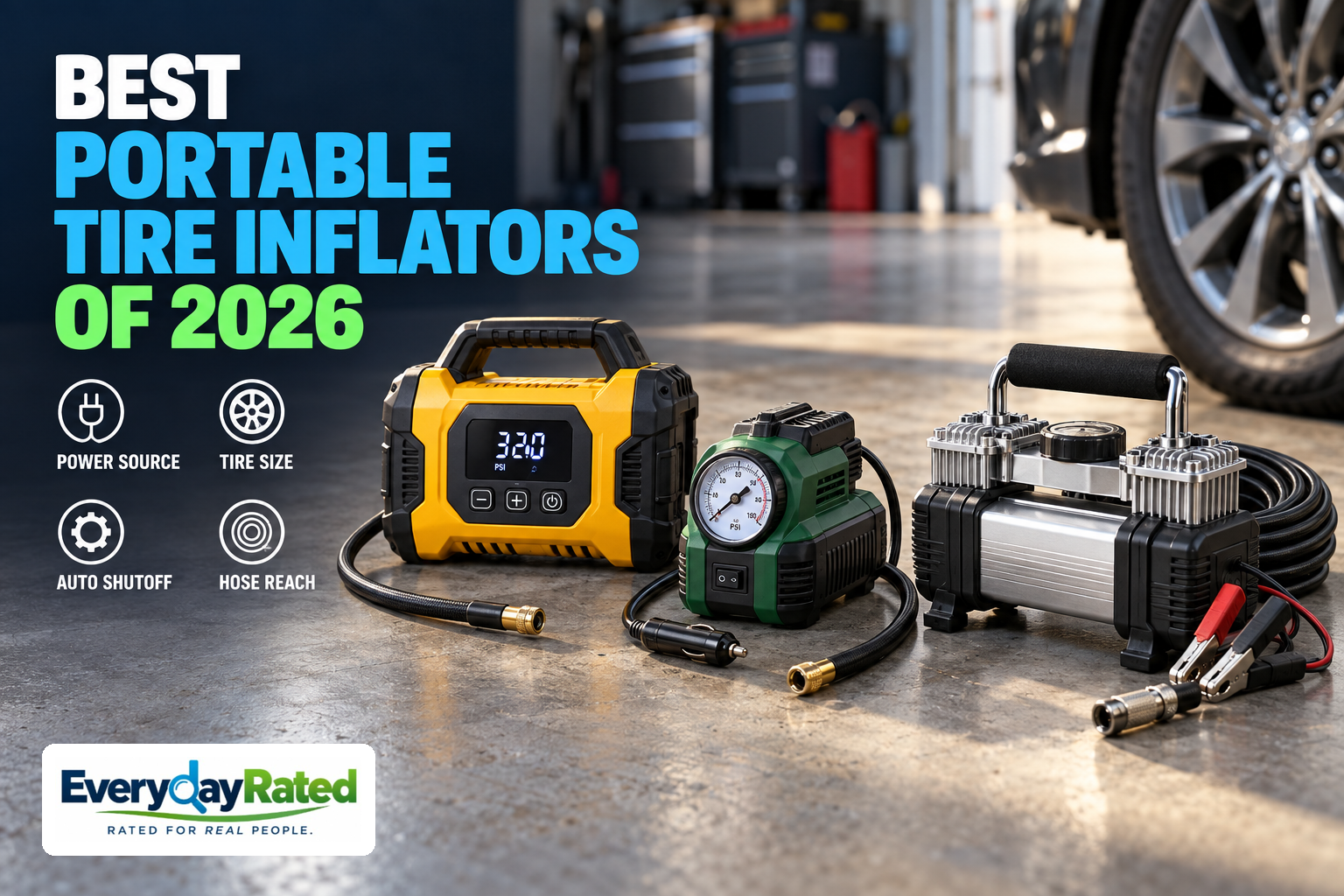
A portable tire inflator makes monthly pressure checks and small corrections easier to handle at home or while traveling. Our Best Overall choice for 2026 is the DEWALT DCC020IB. The Slime 40050 is our budget-value pick, while the analog VIAIR 88P, part 00088, better serves drivers with larger tires and accessible battery connections.
This U.S. guide focuses on everyday cars, crossovers and suitable light trucks. An inflator supplies air; it does not repair tire damage or make a damaged tire safe to drive.
Quick Answer
DEWALT DCC020IB
4.4 / 5
Drivers who want preset inflation and flexible power, especially existing DEWALT battery owners.
Slime 12V Tire Inflator 40050
3.8 / 5
Passenger-car owners who want a low-cost backup and accept manual monitoring.
VIAIR 88P — Analog, Part 00088
4.3 / 5
Truck and SUV owners comfortable connecting battery clamps and checking pressure manually.
How We Evaluated
Last Reviewed: October 2026. EverydayRated compared manufacturer documentation, U.S. sales listings, warranty terms and original professional tests. We have not physically tested these products. These scores are qualitative editorial judgments, not laboratory composites or retailer star ratings.
We prioritized suitability and inflation evidence, followed by pressure control, power access, portability, ownership cost and documentation. DEWALT leads for broad convenience; VIAIR addresses larger tires; Slime earns a cost-focused award with lower confidence in exact-model performance. Each review explains the strengths and deductions behind its score.
We considered alternatives including Fanttik X8 APEX, AstroAI cordless models and the newer digital VIAIR. Compact rechargeable pumps can suit cyclists and light top-ups; battery-platform tools can suit existing owners. Different reviewers use different tires and pressure intervals, so their times do not form one interchangeable ranking. No comparable long-term failure-rate dataset was established.
At-a-Glance Comparison
| Product / score | Power | Pressure control | Price observed | Main compromise |
|---|---|---|---|---|
| DEWALT DCC020IB · 4.4/5 | 20V battery / included 12V cord / optional AC | Digital preset auto-stop | Midrange; bare tool | Accessories cost extra |
| Slime 12V Tire Inflator 40050 · 3.8/5 | 12V accessory socket | Analog; manual stop | Budget tier | Basic controls; limited test evidence |
| VIAIR 88P — Analog, Part 00088 · 4.3/5 | 12V battery clamps | Analog; manual stop | Midrange | Battery access; verify analog version |
U.S. listing prices observed during research on October 7, 2026. Stock, taxes, shipping and discounts vary; these are not checkout guarantees. DEWALT’s battery, charger and AC supply are extra.
[1] [3] [7] [10]1. DEWALT DCC020IB
EverydayRated Score: 4.4 / 5
Key Specifications: 20V MAX battery, 12V vehicle cord or optional AC supply; automatic pressure shutoff; separate high-volume inflation/deflation hose; threaded chuck; LED; battery, charger and AC adapter sold separately.
[1] [3]The DCC020IB earns our overall award for reducing the friction of routine tire maintenance. Set a target pressure, attach the hose and supervise the fill without holding a trigger. For a household using several vehicles, bikes and occasional camping inflatables, its different operating modes are useful rather than decorative. The main advantage is versatility, not the fastest possible inflation.
GearJunkie selected it as its overall winner and reported straightforward controls and substantial construction. Its tested 215/70R16 fill from 10 to 45 psi took 7:42. That is useful evidence of capability, but also a reminder that a large pressure increase takes time. MotorTrend similarly considered it appealing for existing battery owners while questioning its cost and portability for everyone else.
[4] [5]The purchase price needs context. The included vehicle cord lets you operate it without buying a battery. Cordless use requires a compatible charged pack, and household-outlet use requires the specified optional supply. A buyer starting from zero should compare the complete kit cost before treating the bare-tool price as the final bill.
DEWALT lists a three-year limited warranty, one year of free service and a 90-day satisfaction guarantee, subject to terms. These are useful support provisions, not evidence that its failure rate is lower than every rival. We did not establish comparable long-term reliability statistics.
[1]It is a larger item to store than a pocket pump. Keep it where you can reach it beneath luggage, and rehearse the hose and cable routing before a trip. If your only job is a few passenger-car top-ups each year, a cheaper socket-powered pump can be sufficient. If you already maintain DEWALT batteries, this model becomes easier to justify.
Our 4.4/5 score rewards flexible power and convenient controls. The deductions reflect bulk, separately purchased power accessories and moderate filling speed. It wins for the broad everyday use case; it is not our first choice for repeatedly airing up oversized off-road tires.
Pros
- Preset pressure and automatic shutoff simplify routine fills.
- Included 12V cord provides a useful alternative to battery power.
- Separate high-volume mode suits suitable household inflatables.
Considerations
- Cordless and AC accessories increase the full purchase cost.
- Larger to store than compact emergency pumps.
- Substantial pressure increases still require patience and cool-down planning.
2. Slime 12V Tire Inflator 40050
EverydayRated Score: 3.8 / 5
Key Specifications: 12V accessory-socket power; analog dial marked 0–60 psi; manual on/off operation; LED lighting; compact housing; inflation adapters.
[6] [7]The 40050 serves a deliberately modest purpose: keeping an affordable source of air in the vehicle. It makes sense for occasional passenger-car use when buying a cordless tool system would cost far more than the problem warrants. You do not have a separate pump battery to recharge, although the vehicle electrical supply must be usable.
The analog dial and manual switch are the key compromises. You watch the pressure and stop the pump yourself. The dial range is a gauge specification, not proof of suitability for every tire up to that pressure. Slime advertises an eight-minute flat-to-full fill for a standard midsize car tire; that is a manufacturer claim with its own conditions, not a comparative EverydayRated result.
[6]Unlike the other two recommendations, we did not establish comparable original professional testing for this exact model in the reviewed sources. Its recommendation therefore rests more heavily on documented basic functionality and low purchase cost. That evidence gap is reflected in its lower score. We cannot claim it is faster, more accurate or more durable than similarly priced digital alternatives.
For an occasional small top-up, simplicity can be enough. For regular use, poor lighting, difficulty reading a small dial, or several vehicles at once, paying for a digital preset pump may be money well spent. Its low price should not persuade you to use it outside the manual’s runtime, power or tire restrictions.
Slime’s current warranty page lists two years for inflators bought from eligible sellers. An older 40050 warranty sheet lists one year. Confirm coverage for the unit you purchase and retain the receipt; we use the current published policy while disclosing the older discrepancy.
[8] [9]There is no sealant consumable required for ordinary inflation. A separate pressure gauge is a useful addition to the kit, and damaged hoses or plugs should be addressed before the next roadside need. Never compensate for a leaking tire by turning repeated inflation into a permanent maintenance routine.
Our 3.8/5 score recognizes accessible cost and focused operation, with deductions for manual pressure control and limited exact-model independent evidence. Choose it as a basic backup, rather than as the main tool for frequent truck-tire work.
Pros
- Low purchase cost for an occasional-use kit.
- Vehicle power avoids maintaining a separate rechargeable pack.
- Simple controls and compact storage format.
Considerations
- No preset automatic pressure shutoff.
- Analog dial requires attention and a separate final pressure check.
- Less exact-model independent performance evidence than our other picks.
3. VIAIR 88P — Analog, Part 00088
EverydayRated Score: 4.3 / 5
Key Specifications: 12V battery clamps; 120 psi maximum working pressure; tires up to 33 inches; 25-minute duty rating at 30 psi; 10-foot power cord and 16-foot hose; analog gauge; manual control.
[10]The analog 88P is the more purposeful choice when tire volume matters more than cordless operation. It exchanges the convenience of a dashboard socket for a direct battery connection. That makes it less approachable for some drivers, but more relevant for someone who regularly faces larger tire fills and is willing to learn the setup.
GearJunkie found the 88P substantially quicker than its other tested units on a large truck tire. MotorTrend also selected it for trucks and SUVs. Those are independent assessments of tested units, not a guarantee of a particular fill time on your vehicle. Temperature, target pressure, tire volume and the hardware revision all matter.
[4] [5]Do not confuse this recommendation with the newer digital EVC88P. VIAIR sells both, and Road & Track’s recent all-rounder award applies to the digital model. The analog unit remains a current purchase option with relevant historical testing, but its manually controlled operation is part of the bargain. A buyer wanting preset shutoff should investigate the digital version’s exact specifications separately.
[10] [13]There is also a specification conflict worth noticing: the current analog product page lists 1.97 CFM at zero pressure, while VIAIR’s comparison chart lists 1.47 CFM for part 00088. We do not resolve that disagreement by selecting the larger number. Ask VIAIR which specification applies to the shipping unit; neither unloaded airflow number tells you the complete fill time under pressure.
[10] [11]Connection access is the deciding practical test. Check the vehicle manual and the compressor instructions, and confirm approved access to the required power points before buying. Do not improvise a socket adapter for a clamp-powered compressor. Keep hoses clear of heat and moving parts, and use it on a stable surface.
The one-year manufacturer defect warranty requires an eligible seller and has shipping conditions. The absence of a rechargeable pack removes one maintenance task, but it does not remove hose inspection, careful storage or runtime limits. There are no comparable population failure-rate data establishing lifetime durability.
[12]Our 4.3/5 score rewards its relevance to larger tires and independent performance support. Deductions reflect manual control, battery-access requirements and the unresolved airflow specification. For oversized tires beyond the stated fitment or repeated high-pressure RV work, move to a compressor explicitly specified for that job.
Pros
- Independent testing supports larger-tire usefulness.
- Long hose helps reach tires from the power connection.
- No separate rechargeable tool battery to maintain.
Considerations
- Requires suitable battery access and correct clamp setup.
- Analog version lacks preset pressure shutoff.
- Manufacturer airflow listings disagree; confirm the shipping configuration.
Buyer’s Guide: What Matters Before You Buy
1. Match tire volume and pressure, not the biggest PSI claim
Maximum PSI describes a pressure limit. It does not tell you how quickly a pump moves air into a large tire. A small unit may reach bicycle pressure yet struggle with the volume of a truck tire. Look for tests on a comparable tire and a comparable starting-to-target pressure interval.
A top-up from a few PSI low is a different job from filling a completely deflated tire. For regular off-road reinflation, high-pressure trailer tires or several large tires in succession, prioritize a compressor documented for that workload. A compact emergency pump can be the wrong economy even if its advertised pressure ceiling looks adequate.
2. Choose a power source you can actually access
A rechargeable pump is easy to move around a vehicle, but needs a charging and storage routine. A tool-platform inflator can be excellent value if you already own the right batteries. If not, compare the full battery-and-charger cost with a ready-to-use pump.
A socket-powered unit depends on the vehicle outlet’s electrical rating and availability. Battery-clamp models demand accessible, approved power connections and careful routing. Check your vehicle manual, especially for hybrids and EVs, and follow the inflator’s exact instructions. If operation requires a running engine, work outdoors away from enclosed spaces.
3. Treat preset shutoff as convenience, then verify pressure
Digital preset control reduces the need to judge a moving dial, but it does not eliminate supervision or a final pressure check. A secure chuck, readable display, usable hose length and stable feet can matter more than phone-charging ports. Check that the hose reaches a valve near the top of the wheel without pulling on it.
NHTSA recommends checking tires cold, meaning the vehicle has not been driven for at least three hours, and using the vehicle’s recommended pressure on its placard or manual. The tire sidewall’s maximum is not your routine target. Check monthly and include the spare where applicable. A separate reliable gauge helps verify the final result.
[14]4. Plan for heat, storage and the cost of ownership
A duty rating applies under specified conditions. VIAIR’s 25-minute rating at 30 psi should not be read as unlimited operation at 120 psi. Higher pressure, hot weather and repeated fills can change the workload. Follow the unit’s runtime and cooling instructions, and keep hands away from hot compressor parts and fittings.
Ordinary inflation requires no sealant refill or subscription. The recurring costs are power, possible battery replacement and worn hoses or fittings. Store the kit within the specified temperature limits, inspect it before trips and keep the receipt. Warranty length describes contractual coverage; it does not measure reliability.
If a tire loses air repeatedly, have the cause investigated. If it is visibly damaged, has been driven severely underinflated or cannot retain pressure, use an appropriate spare or roadside assistance rather than assuming a refill solves the problem.
Related Buying Guides
If pressure checks reveal that your tires are due for replacement, see our best all-season tires of 2026. For a broader cold-weather vehicle kit, our ice scrapers and snow brushes guide covers another useful preparation step.
EverydayRated Verdict
DEWALT DCC020IB is our Best Overall portable tire inflator of 2026 for everyday versatility, particularly if you already own compatible batteries. Its preset controls and multiple power options make routine maintenance easier to fit into a household’s habits.
Choose Slime 40050 when low cost and basic passenger-car backup use matter most, and accept the need to stop it manually. Choose the analog VIAIR 88P, part 00088, when larger-tire capability matters more than cordless convenience. Confirm the exact analog or digital version and its specifications before ordering.
You may not need another pump if you already have a suitable compressor or convenient access to air. If you buy one, match it to your tires and power access first. The best kit is one you can connect correctly, supervise and store ready for use.
Sources & Research
Accessed October 7, 2026. Testing applies to the hardware and conditions actually evaluated. Specifications and warranty terms are manufacturer statements; retail listings provide price context.
- DEWALT DCC020IB specifications, included items and warranty
- DEWALT current Type 3 instruction manual
- Home Depot — DCC020IB purchase listing
- GearJunkie — original comparative inflation tests
- MotorTrend — original portable inflator evaluations
- Slime 40050 — current product information
- Academy — Slime 40050 purchase listing
- Slime — current limited warranty
- Slime 40050 — older model warranty sheet
- VIAIR analog 88P, part 00088 — current product listing
- VIAIR — portable inflator comparison chart
- VIAIR — warranty terms
- Road & Track — 2026 testing, including newer digital EVC88P
- NHTSA TireWise — pressure checks and tire safety