
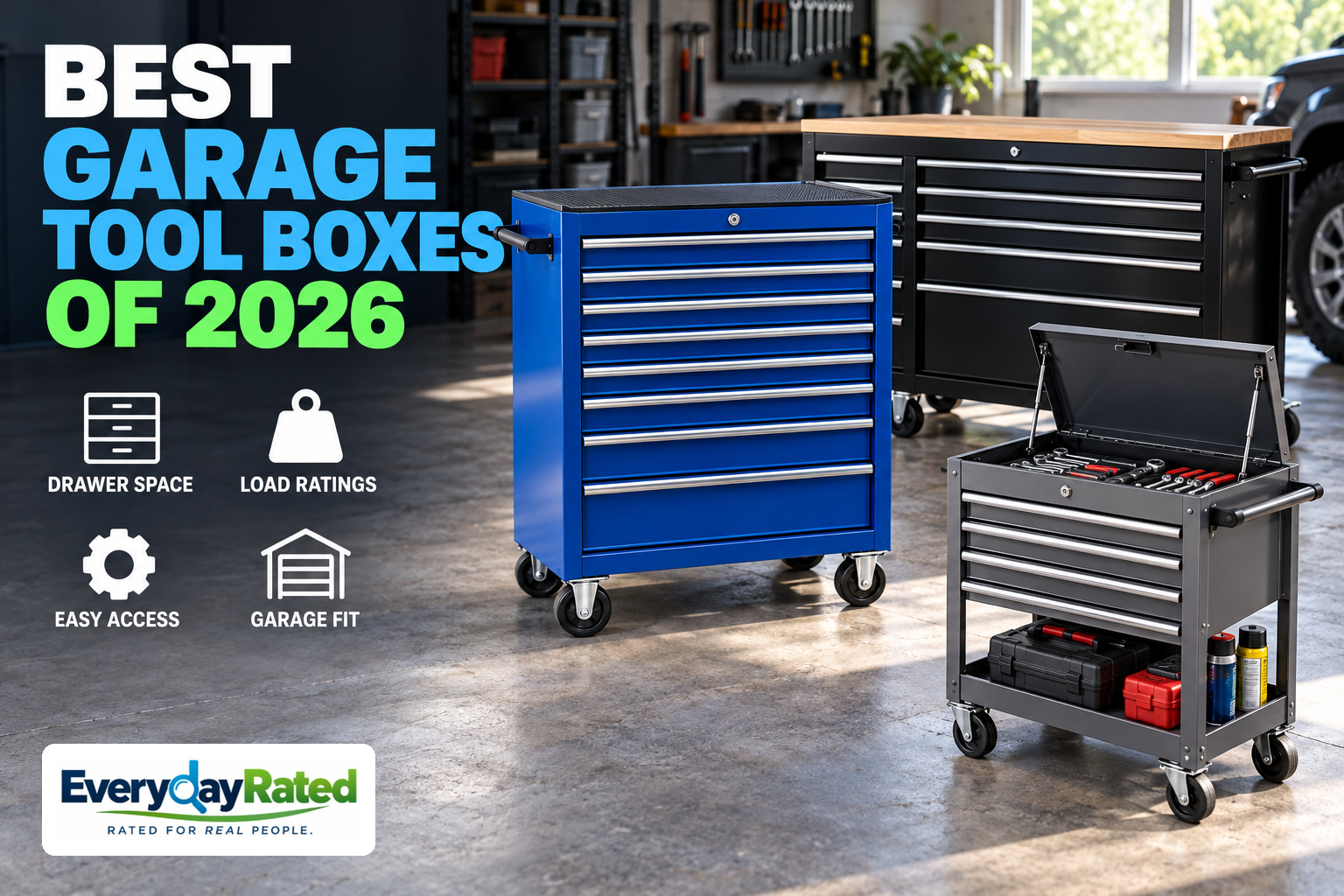
The best garage tool box for most home DIYers is the Husky 46-Inch Deep 9-Drawer Mobile Workbench. It combines drawer storage with a useful project surface. Choose the U.S. General 42-Inch Series 3 for an expandable storage setup, or the U.S. General Five-Drawer Mechanics Cart for a lower-cost mobile selection.
This U.S. buying guide covers rolling steel garage storage for hand tools, power-tool accessories and routine projects. We compared storage layout, access, footprint, ownership support and total purchase cost. These three solve different jobs; the cart is not a capacity-equivalent substitute for either cabinet.
Quick Answer
Husky 46-Inch Deep 9-Drawer Mobile Workbench — H46MWC9V2-C
4.3 / 5
Homeowners who want organized drawers and a usable project surface in one purchase.
U.S. General 42-Inch Series 3 Roll Cab — 70373
4.2 / 5
Growing mechanics-tool collections where a compatible expansion system matters more than a wood bench.
U.S. General 30-Inch 5-Drawer Mechanics Cart — 70375
4.1 / 5
Smaller tool collections or frequently used tools that need to move beside a project.
How We Evaluated
Last Reviewed: October 2026. Research completed October 8, 2026. EverydayRated has not physically tested these products. Ratings are research-based editorial judgments, not laboratory results or retailer star averages.
We prioritized usable drawer layout and access, fit in a working garage, documented load limits, ownership support and total cost. Review evidence was weighted by its relevance to the exact model. We did not establish comparable long-term failure rates or controlled load tests for all three selected SKUs.
Professional evaluations informed the questions we asked, while current store listings and manufacturer manuals supplied specifications. Older reviews and different widths remain explicitly identified. A paid partnership was reviewed as context and was not treated as independent evidence. No single outside ranking determined our selections.
Alternatives considered included the larger 56-inch Series 3, ICON professional storage, the Yukon wood-top cabinet and portable modular cases. The first two address larger collections or different ownership expectations; portable systems serve travel. We chose three distinct home-garage uses rather than assume every buyer needs a premium chest.
[7] [8] [9] [10]At-a-Glance Comparison
| Product / score | Layout | Size / fit | Load information | Price / tradeoff |
|---|---|---|---|---|
| Husky deep 46-inch · 4.3/5 | 9; wood worktop | 46 in. nominal W; current title 24 in. D | 100 lb. rated slides; confirm shipping-unit total | Midrange; general home workspace |
| U.S. General 42-inch · 4.2/5 | 10; expandable cabinet | 42 × 22 × 41¼ in. nominal; handle clearance extra | 2,600 lb. overall; 120 lb. per slide pair | Midrange; expansion costs extra |
| U.S. General five-drawer · 4.1/5 | 5; open lower shelf | 37¼ × 22 × 41⅜ in. listed | 700 lb. overall; 75 lb. per slide pair | Budget-oriented; only 6,900 cu. in. lockable |
Store listing prices observed October 8, 2026, before tax, delivery and accessories. Temporary promotions and credit-card offers are excluded. Local inventory and final delivery availability require a ZIP-code check. Overall and individual drawer limits are separate; confirm the supplied manual and label.
[1] [3] [5]1. Husky 46-Inch Deep 9-Drawer Mobile Workbench — H46MWC9V2-C
EverydayRated Score: 4.3 / 5
Key Specifications: 46 in. nominal width; 24 in. nominal depth in the current title; nine drawers; solid wood top; 100 lb. rated soft-close slides; six power outlets and two USB ports. Confirm full assembled footprint and shipping-unit load label.
[1]The Husky is our first choice for a typical home garage because it solves two everyday problems at once: where to keep hand tools and where to put the part you are working on. That combination is more useful to many weekend DIYers than a taller chest that adds drawers but occupies the entire work surface. The recommendation is for the deep H46MWC9V2-C listing, not every black Husky cabinet with a 46-inch badge.
A useful way to judge this purchase is to lay out the tools for your most frequent job. If sockets, pliers and fasteners can each have a clear home while the project sits above them, a workbench cabinet can simplify the work. If your priority is storing a very large collection of long tools, a different drawer arrangement may matter more than the wood top.
Car and Driver liked a shallower 46-inch Husky’s drawers and value but noticed caster wobble. Its dimensions differ from this deep model, so we do not transfer that finding as a measured defect here.
[7]Pro Tool Reviews’ older 52-inch Husky review supplies additional historical context on drawers and slides. It concerns different units and is not a current-model endurance test. Humble Mechanic described using an older deep 46-inch workbench during a transmission project and noted drawer access and movement limitations; that article explicitly discloses a paid Home Depot partnership. We treat it as attributed owner experience, not independent confirmation.
[8] [9]The practical compromise is the bench itself. Wood benefits from protection when you handle oily parts, sharp edges or abrasive components. A removable protective mat or parts tray can preserve the surface without turning it into permanent storage. Clear the top after a job; otherwise the feature that justified buying a workbench disappears under chargers and containers.
Choose this cabinet when it will normally live in one area. Casters make repositioning possible, but a loaded rolling cabinet is not a portable jobsite box. Account for the handle, outlets and cord route, and leave space to stand in front of a fully extended drawer. The nominal dimensions in the product title do not replace an assembled measurement.
The manufacturer’s V2 family guide states a three-year limited warranty. Its model list omits the current -C suffix, so confirm that coverage and the exact load label with Home Depot before ordering. We have not mixed the family manual’s caster rating with reseller payload figures to create a single unsupported capacity.
[2]Our 4.3/5 score rewards useful home-garage functionality and purchase value. Deductions reflect the footprint, the care required by a wood surface, and limited exact-model long-term evidence. The score is an editorial judgment about suitability, not a prediction that the drawers will remain trouble-free for a particular number of years.
Pros
- Combines tool storage with a practical wood work surface.
- Soft-close drawers and built-in outlets are convenient for a home workspace.
- Good starting point when you need both a bench and organized storage.
Considerations
- Deep footprint needs room for drawers and the user.
- Wood top needs protection during dirty or abrasive work.
- Confirm shipping-suffix warranty and overall load rating.
2. U.S. General 42-Inch Series 3 Roll Cab — 70373
EverydayRated Score: 4.2 / 5
Key Specifications: White SKU 70373; 10 drawers; 16,700 cu. in. listed storage; 2,600 lb. listed working load; slides rated 120 lb. per pair; 42 × 22 × 41¼ in. nominal cabinet; allow extra handle clearance; 90-day limited defect warranty.
[3] [4]The 42-inch Series 3 is the stronger alternative when your storage plan extends beyond the first cabinet. Start with the base and decide later whether a compatible top chest or side unit solves an actual space problem. This approach suits someone collecting more mechanics tools who already has a separate bench.
Our preference here is about layout and future options. A nominally narrower cabinet can fit a different wall space from the Husky, but the advertised size is not its complete operating footprint. Draw a floor plan that includes the handle and an open drawer before interpreting 42 inches as a guaranteed fit. A cabinet that forces you to move the car every time you want a ratchet is inconvenient regardless of its capacity.
Car and Driver examined a larger 56-inch Series 3 and found easy drawer operation but lighter-feeling construction than ICON. Those impressions describe that larger unit, not a direct test of this 42-inch cabinet.
[7]Use the drawer plan as the deciding factor. Put socket rails, wrench trays and your longest frequently used tool on paper, then compare their dimensions with the actual drawer interiors. Several shallow drawers can be efficient for hand tools, while bulky blow-molded cases may need deep drawers or separate shelving. A larger cubic-inch number does not tell you whether your organized tools will fit.
Expansion also creates a cost decision. A base cabinet plus a top chest can stop being the lower-cost solution once delivery, accessories and organizers are included. Price the complete arrangement you expect to own. If you only need a little more room, reorganizing or moving bulky cases to shelves may accomplish more than buying another steel module.
The 90-day included defect warranty is a meaningful weakness. Inspect the cabinet promptly, retain the receipt, and ask about parts support for the exact SKU. A higher load rating is not evidence of a longer service life. Follow the manual for individual drawer limits and permissible combinations rather than dividing the overall rating by the number of drawers.
[3] [4]Our 4.2/5 rating reflects the value of a documented modular platform for an expanding collection. Deductions cover short included coverage, additional expansion cost and limited direct current-size test evidence. Choose it for a clear storage plan; buyers who need a ready-to-use wood worktop are better served by the Husky.
Pros
- Compatible expansion options support a growing collection.
- Ten drawers give hand tools distinct storage locations.
- Published drawer-slide and overall ratings help with planning.
Considerations
- Only 90 days of included defect coverage.
- Top chest and side storage add cost and footprint.
- No included wood workbench; exact-size durability evidence is limited.
3. U.S. General 30-Inch 5-Drawer Mechanics Cart — 70375
EverydayRated Score: 4.1 / 5
Key Specifications: Slate gray SKU 70375; five drawers; 15,000 cu. in. total storage, including 6,900 cu. in. lockable storage; 700 lb. working load; slides rated 75 lb. per pair; 37¼ × 22 × 41⅜ in. listed footprint; 144 lb.; 90-day limited defect warranty.
[5] [6]This cart is our value choice because it can organize the tools you use most without requiring the space or cost of a large cabinet. It also makes sense beside an existing toolbox: put the tools for the current job on the cart and leave the rest stored elsewhere. That is a useful reason to own two storage units, provided each has a defined purpose.
Do not compare its advertised volume directly with a closed roll cabinet. Some of that total belongs to the exposed lower storage area. The lockable figure is the better starting point if you want all your hand tools behind a lock. An open shelf is useful for large cases, but it offers different protection from dust and casual access.
The current cart has a pass-through power port, not a promise of an included six-outlet power strip. Its drawers lock automatically when the lid closes, and the folding side tray is sold separately. Plan for an open lid during drawer use and count accessory cost before comparing it with a cabinet.
[5]Despite the 30-inch name, the published overall length is substantially wider. Check the route around a parked vehicle, doorways and the place where you intend to store it. It is also a substantial steel tool rather than something to lift into a trunk after every job. For stairs, gravel or frequent travel, purpose-built portable cases are a different buying category.
Direct comparative testing for the current 70375 was not established in the reviewed professional sources. We do not apply results for U.S. General’s four-drawer Tech Cart to this five-drawer model. The award rests on the documented layout, lower regular price and suitability for keeping a working selection close at hand.
Keep loads within both drawer and cart limits, and close and secure the storage before moving. A loaded top compartment is not a seat or a work platform. Follow the supplied manual for assembly and inspections; do not judge stability from an empty showroom example alone.
[6]Our 4.1/5 score reflects useful value for a focused collection, with deductions for limited enclosed capacity, lid-dependent access, short warranty and the evidence gap. It is a sensible first step when it fits your tools now. If it would be crowded immediately after buying organizers, start with a suitable cabinet instead.
Pros
- Lowest regular purchase price among these three picks.
- Useful as a first toolbox or a project-side companion.
- Open shelf accommodates bulky cases.
Considerations
- Only part of the advertised volume is lockable.
- Lid must be open for normal drawer access.
- Wider and heavier than the name suggests; short warranty.
Buyer’s Guide: Four Checks Before You Buy
1. Measure the working space, not just the wall
Start with the car parked in its normal position. Mark the proposed cabinet on the floor, then add an open drawer and room for your body. Include handles, side accessories, electrical plugs, lid travel and any future chest. Check garage-door tracks and shelves above the unit.
Plan delivery as carefully as placement. Find out whether service ends at the curb or includes moving the cabinet into the garage. A step, narrow doorway or steep driveway can make the cheapest delivery option impractical. Inspect packaging and the cabinet before disposing of it.
2. Match drawers to your actual tools
Sort tools into shallow hand tools, taller accessories and bulky cases. Measure your organizers before buying. Socket rails and foam can use more height than loose sockets, while long breaker bars need usable internal width. Fewer deep drawers can waste space on small tools; too many shallow drawers can leave cases homeless.
If you are building the collection as well as choosing storage, compare our mechanic tool sets for home garages before deciding how much drawer space you need.
Leave deliberate room for likely additions. Buying a cabinet that is nearly full on day one often leads to clutter on top. Conversely, an enormous chest for a small collection consumes floor space that could support the work itself. Ask which tools you expect to add, then reserve space for those rather than an undefined future collection.
3. Read ratings and stability instructions separately
Overall working load does not mean each drawer can hold that amount. Respect the individual drawer rating and how the manufacturer defines total load, including any top chest. Open one drawer at a time, distribute heavy items low, and secure the drawers before movement. Park with the brakes engaged on an appropriate level surface.
Follow the exact manual for assembly, inspection, permitted accessories and movement. A caster makes something roll; it does not make every slope, threshold or surface suitable. Cabinet locks help control access but should not be treated as a substitute for garage security. Keep children away from drawers and climbing opportunities.
[4] [6]4. Budget for ownership and the complete setup
Compare the delivered total, including liners if absent, organizers, worktop protection and planned modules. These products have no subscription fees. Routine ownership involves cleaning and the manufacturer’s specified inspections and maintenance; damaged slides, locks or casters can create parts and labor costs.
Ask how replacement parts are ordered and keep the receipt, model label and keys documented. A warranty defines eligible coverage, not expected lifespan. Do not assume a brand’s hand-tool lifetime warranty applies to its storage furniture. Confirm the selected model and suffix before paying.
For integrated power, follow the cabinet and charger instructions, keep electrical connections dry and disconnect before moving as directed. A cable pass-through is different from a supplied power strip. Do not infer a safe charging setup solely from a product photo.
[2] [4] [6]EverydayRated Verdict
The Husky deep 46-inch workbench is our Best Overall garage tool box of 2026 for typical home projects. Its combination of storage and a work surface addresses the needs of a garage that must do more than hold tools.
Choose the U.S. General 42-inch Series 3 when a growing collection and compatible expansion are the priorities. Choose the five-drawer mechanics cart for lower initial spending or a mobile working selection, while accepting its smaller enclosed capacity.
You may not need any of these if your tools fit comfortably in existing shelves and a small portable box. Before ordering, measure the actual working footprint, map your tools to drawers and confirm the delivered model, warranty and total price. A well-planned modest cabinet is more useful than a large one that obstructs the garage.
Sources & Research
Accessed October 8, 2026. Professional impressions, sponsored owner experience, manufacturer specifications and editorial analysis are distinguished above. Targeted recall research did not establish a matching recall for these selected SKUs; that is not recall clearance. Check the exact item number before buying used equipment.
- Home Depot — Husky H46MWC9V2-C, current listing and price
- Husky — H46MWC9V2 family use and care guide; confirm applicability to shipping suffix
- Harbor Freight — U.S. General 42-inch Series 3, white 70373
- U.S. General — 42-inch Series 3 owner’s manual
- Harbor Freight — U.S. General five-drawer mechanics cart 70375
- U.S. General — 70375 owner’s manual
- Car and Driver — garage-toolbox evaluations, updated January 2026; different sizes from our selected units
- Pro Tool Reviews — historical 52-inch Husky evaluation, December 2016
- Humble Mechanic — historical 46-inch Husky experience; explicitly paid partnership, January 2019
- Harbor Freight — current tool-storage alternatives and price context
- CPSC — recall lookup