
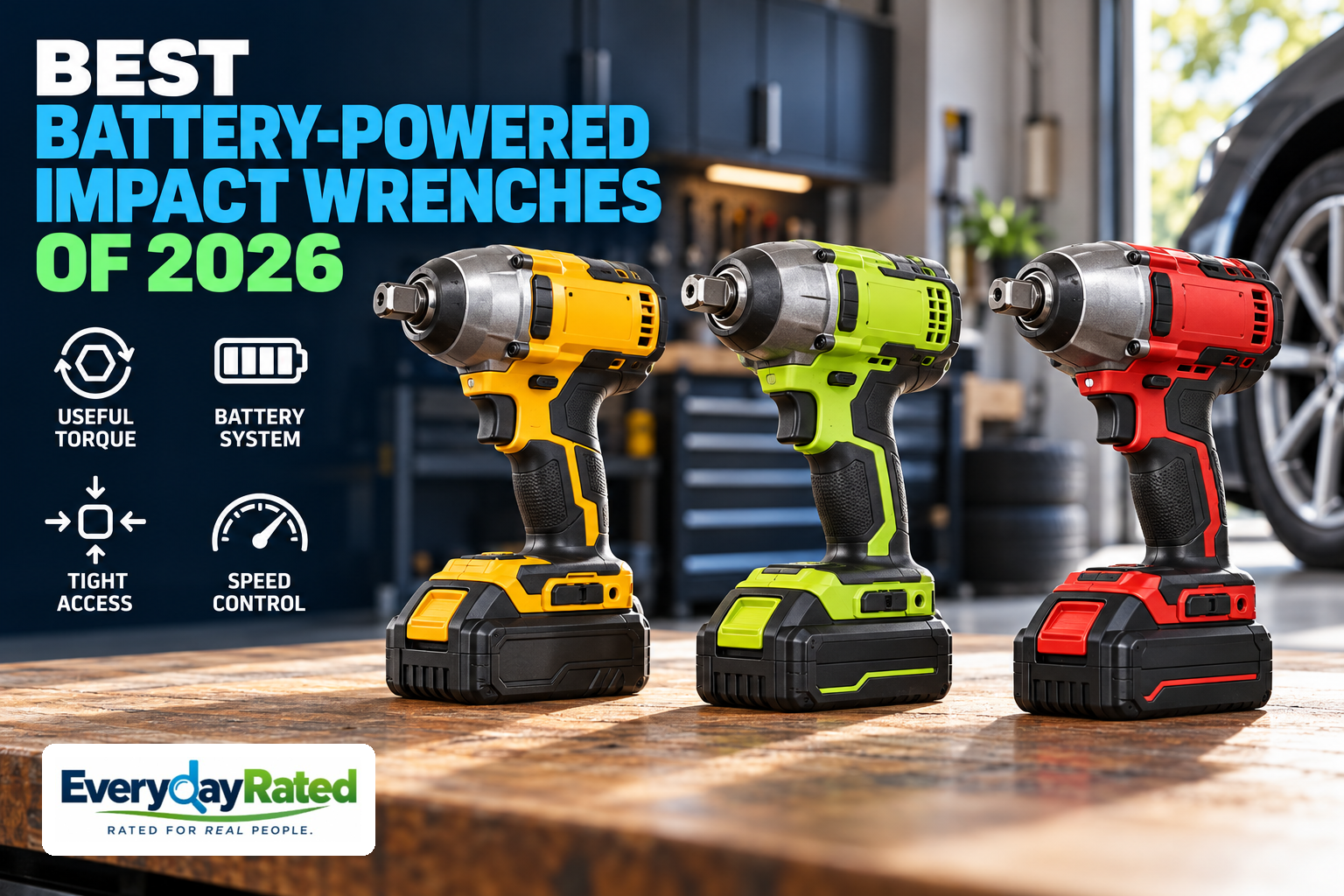
The DEWALT DCF891B is our Best Overall battery-powered impact wrench of 2026 for general home-garage automotive work. RYOBI’s P262 is the value choice, while Milwaukee’s 2962-20 favors tighter access and existing M18 owners. These three 1/2-inch square-drive tools target wheel removal and suitable mechanical work.
This U.S. guide focuses on useful mid-torque tools for passenger vehicles and compatible light-truck jobs. A screw-driving impact driver, compact ratchet and heavy commercial-truck wrench solve different problems. No cordless wrench can guarantee removal of every rusted, damaged or overtightened fastener.
Quick Answer
DEWALT 20V MAX XR DCF891B
4.5 / 5
Home mechanics seeking a versatile first 1/2-inch impact wrench, especially existing DEWALT battery owners.
RYOBI ONE+ HP Brushless P262
4.2 / 5
Occasional DIY mechanics who want a lower-cost wrench, particularly households already using ONE+ batteries.
Milwaukee M18 FUEL 2962-20
4.4 / 5
M18 owners and mechanics who prioritize a shorter mid-torque tool for restricted working space.
How We Evaluated
Last Reviewed: October 2026. Research conducted October 8, 2026. EverydayRated has not physically tested these products. Scores are qualitative editorial assessments, not measured torque ratings, retailer reviews or calculated laboratory composites.
We applied the same priorities to all three: relevant removal evidence first, working access and control second, then complete ownership cost, battery compatibility and support. We reserve score deductions for meaningful compromises and evidence gaps. Milwaukee’s higher score than the second-listed RYOBI reflects stronger access and support; RYOBI appears second because its value award serves a different buyer.
Original Pro Tool Reviews testing supplies the most directly comparable recent evidence. Its 2025 head-to-head used different upgraded batteries across brands. Tool Box Buzz adds an older indexed P262 result; Car and Driver’s separate automotive tests considered other models, helping define alternatives rather than validating this shortlist. We do not merge their test fixtures or treat multiple articles reporting the same experiment as independent replications.
[10] [11] [12] [13]We also considered compact Milwaukee M12 and heavy DEWALT alternatives. The former prioritizes access; the latter targets harder removal work. Neither automatically improves a first purchase for routine wheel service. Comparable long-term failure rates and a complete current-model recall clearance were not established.
[14] [15]At-a-Glance Comparison
| Product / score | Rated fastening / removal | Size context | Bare-tool price | Main distinction |
|---|---|---|---|---|
| DEWALT DCF891B · 4.5/5 | 600 / 800 ft-lb | 6.95 in.; 3.7 lb bare | Midrange | Balanced performance; larger than Milwaukee |
| RYOBI P262 · 4.2/5 | 450 / 600 ft-lb | Longest in cited 2025 group | Value tier | Lower price; access compromise |
| Milwaukee 2962-20 · 4.4/5 | 550 / 650 ft-lb | 6 in.; 3.5 lb bare | Upper midrange | Shorter head; premium entry cost |
Torque figures are manufacturer claims, not comparable EverydayRated measurements. Prices are U.S. listing observations before tax, shipping and accessories; promotions and regional stock change. The three bare tools exclude battery and charger. Full purchase cost can change the value ranking.
[1] [2] [3] [4] [6] [7] [8]1. DEWALT 20V MAX XR DCF891B
EverydayRated Score: 4.5 / 5
Key Specifications: 1/2-inch hog-ring anvil; brushless; manufacturer-rated 600 ft-lb fastening / 800 ft-lb breakaway; three speeds plus Precision Wrench mode; 6.95-inch length; 3.7 lb without battery.
[1] [2]The DCF891B is our overall recommendation for a mixed home-garage workload. It offers useful removal performance without committing the buyer to the size of a heavy high-torque wrench. That is the right starting point for someone rotating wheels and doing occasional suspension work on compatible passenger vehicles. It earns the award for the balance of evidence, capability and ownership value, rather than the largest torque claim.
Pro Tool Reviews’ original DCF891 evaluation reported a 23.77-second total for eight nuts tightened to 500 ft-lb, and full insertion of its large lag screw within the test period. Its separate inertia-torque result was mid-pack. Those differing outcomes show why one torque number is insufficient to judge application speed. These are the reviewer’s controlled tests, not EverydayRated measurements or a promise about a corroded fastener on your vehicle.[11]
The more useful question is what happens in your garage. A wrench has to fit with the socket attached, line up squarely and remain comfortable while you reach the fastener. Compare that complete working envelope before ordering. This model is a sensible general-purpose choice, but it should not be the automatic answer when restricted access is the main problem.
DEWALT’s Precision Wrench setting is intended to reduce overtightening and fastener run-off. It adds control; it does not turn the wrench into a calibrated tightening instrument. The manufacturer lists three-year limited coverage, one year of free service and a 90-day satisfaction guarantee, subject to terms. Battery and charger are extra with the B version linked here.[1] [2]
Purchase cost deserves a close look. Compare the current Home Depot and Ohio Power Tool offers for the exact configuration. Treat those as changing listing observations. If the sale disappears, compare complete kits and competing tools again. A buyer with no batteries should price the wrench, suitable pack and charger together before calling the bare tool a bargain.[3] [16]
Our 4.5/5 score rewards strong application evidence and a broad automotive use case. Deductions reflect the battery purchase burden, its less compact envelope and the absence of comparable long-term failure-rate evidence. Existing M18 owners should give the Milwaukee serious consideration before buying into a second battery platform.
Pros
- Strong published application-test evidence for this model.
- Useful compromise between a compact wrench and a bulky high-torque tool.
- Precision Wrench mode adds control during fastening and removal.
Considerations
- Battery and charger are additional purchases with DCF891B.
- Not the shortest option for restricted working space.
- Published upgraded-battery tests do not establish performance with every pack.
2. RYOBI ONE+ HP Brushless P262
EverydayRated Score: 4.2 / 5
Key Specifications: 18V ONE+; 1/2-inch friction-ring anvil; brushless; manufacturer-rated 450 ft-lb fastening / 600 ft-lb breakaway; three speeds plus Auto mode.
[4]The P262 is our value pick for occasional wheel and repair work. Its appeal is straightforward: it offers the main features that make a cordless impact wrench useful while leaving more room in the budget for a torque wrench, sockets and the rest of the garage setup. Existing ONE+ owners have the strongest reason to start here.
In Pro Tool Reviews’ 2025 comparison, P262 averaged 4.16 seconds on its bolt-break test using a 4.0Ah High Performance Edge battery. Milwaukee averaged 3.26 seconds with an 8.0Ah FORGE pack. RYOBI was the longest tool in the group. These results support its usefulness and identify an access compromise, but the different packs prevent treating this as a battery-neutral motor comparison.[10]
An earlier Tool Box Buzz mid-torque comparison also included P262 and ranked it first in its timed lug-removal task. That historical result is a useful second perspective, not a reason to merge times from different fixtures into one leaderboard. The full page could not be retrieved during this research; only its indexed result was available, so we do not reproduce detailed protocols or extrapolate durability.[12]
The official store displayed a tool-only option alongside a separate battery-and-charger option. Confirm which option is selected before ordering. RYOBI documents three speeds and an Auto mode; the manual states a three-year limited warranty. Those provisions make the tool credible for this use case, although warranty duration does not establish how long an individual unit will last.[4] [5]
Choose it when the work is occasional and the lower complete purchase cost survives a battery comparison. If buying a premium pack solely to reproduce a reviewer’s result makes the package approach the cost of a competing kit, revisit the decision. Conversely, an existing compatible pack can make a modest tool purchase far more useful than starting a new system for a small performance improvement.
Its 4.2/5 score reflects convincing value and useful published performance, with deductions for access, battery-dependent results and limited long-term evidence. It is our cost-conscious recommendation rather than a claim that every fastener can be removed. Very tight suspension access or repeated demanding shop work can justify choosing another tool or a second, specialized wrench.
Pros
- Lower observed bare-tool price than the premium shortlist.
- Published tests support practical capability beyond the specification sheet.
- Convenient addition to an existing ONE+ household.
Considerations
- Longest tool in the cited comparison; inspect socket clearance.
- The cited 2025 result used an upgraded Edge battery.
- New buyers still need to budget for battery and charger.
3. Milwaukee M18 FUEL 2962-20
EverydayRated Score: 4.4 / 5
Key Specifications: 18V M18; 1/2-inch friction-ring anvil; brushless; manufacturer-rated 550 ft-lb fastening / 650 ft-lb removal; 6-inch length; four control modes.
[6] [7]The 2962-20 is the most appealing alternative when working room matters as much as removal power. A shorter body can make the difference between a straight approach and awkward positioning, although the socket, battery and surrounding components still determine whether the assembly fits. This award concerns tighter access among our mid-torque picks; it does not mean this is the smallest impact wrench available.
The 2025 Pro Tool Reviews comparison measured Milwaukee’s tool length at 5.88 inches, shorter than the other models it evaluated. Its 3.26-second average bolt-break result with an 8.0Ah FORGE battery was close to the leader. We give those findings weight while retaining the battery qualification; neither result guarantees access or speed on a specific car.[10]
Milwaukee specifies a 6-inch body, front-mounted lighting and four control modes. The assisted mode limits forward output and slows removal after the fastener releases. Its manual lists 3.5 lb without battery; the manufacturer’s 5.1 lb marketing figure includes a 5.0Ah battery. Compare weights on the same basis when shopping.[6] [7]
The purchase listing checked for 2962-20 excluded the battery and charger. Milwaukee’s U.S. limited warranty generally covers eligible power-tool defects for five years, subject to exceptions; packs have their own terms. That support is useful, but no comparable dataset established a lower failure rate than the other recommendations.[8] [9]
For someone already using M18, avoiding another charger and battery family can outweigh a modest difference in removal speed. For someone starting from zero, compare a complete kit against DEWALT before paying the premium. Try the grip and check pack clearance if possible. A short head with a large battery can still be awkward around a wheel well.
Our 4.4/5 score rewards access, competitive evidence and ownership support. Its deductions reflect purchase cost and the need to qualify performance by pack. Reports of a newer 3962-20 appeared in searches, but we could not establish a current purchasable release from manufacturer or retailer documentation. This recommendation is specifically for the verified 2962-20 listing, not an unreleased successor.
Pros
- Short body within the documented mid-torque comparison.
- Competitive published removal performance with the stated battery.
- Useful existing-M18 fit and five-year limited tool coverage.
Considerations
- Premium bare-tool price; packs and charger cost extra.
- Socket and battery can still prevent access.
- Successor availability remains unverified; confirm exact model before purchase.
Buyer’s Guide: Choose the Right Impact for Your Garage
1. Match the tool class to the job
Start with your actual fasteners and working space. For a first automotive wrench, a mid-torque 1/2-inch model is a practical category to compare. If the work is mainly recessed engine-bay fasteners, evaluate a compact wrench or powered ratchet instead. If the main challenge is repeated severe removal work, a high-torque model may justify its bulk.
For context, Milwaukee rates its M12 2563-20 compact wrench at up to 550 ft-lb removal torque, while DEWALT rates the much larger DCF961 at up to 1,750 ft-lb breakaway. Those claims illustrate different product classes, not a common test scale. Neither belongs in a universal “strongest is best” ranking.
[14] [15]Choose the wrench after considering the work, rather than inventing work to justify an impressive specification. A manual tool may be enough for infrequent jobs. An impact wrench also does not replace appropriate lifting equipment, vehicle instructions or judgment about a damaged fastener.
2. Read torque claims as conditional capability
Fastening torque and breakaway torque describe different tasks. Do not compare one manufacturer’s fastening figure against another’s removal figure. Test duration, pack, socket and fastener conditions also influence results. A nut originally tightened to a stated torque does not necessarily need exactly that torque to loosen later.
Milwaukee’s manual explicitly says output depends on battery size and charge, impacting time and bolt size. It also requires checking the achieved torque with a torque wrench. Treat speed modes and assisted shutoff as operating aids, not selected final torque values.
[7]For wheel installation, follow the vehicle manufacturer’s complete procedure and specified sequence. Start threads correctly, avoid driving a misaligned nut, and use the appropriate torque wrench for final tightening. Do not assume an impact’s lowest mode is safe for every fastener.
3. Price the battery system and usable working envelope
Write down the complete bill: tool, suitable battery, charger, correctly sized impact sockets and torque wrench. If you already own a compatible platform, compare the incremental cost first. If starting from zero, compare kits with equivalent pack and charger contents. A bare-tool discount can disappear once the power accessories are included.
For the separate hand-tool portion of your garage, see our mechanic tool set comparison. Those general-purpose sets do not replace impact-rated sockets or a torque wrench.
The cited 2025 test used an 8.0Ah PowerPack for DEWALT, 8.0Ah FORGE for Milwaukee and 4.0Ah Edge for RYOBI. This matters when interpreting results or budgeting. We have not established a universal minimum battery that reproduces those findings, and a small pack should not be assumed to match them.
[10]Check total length with your intended socket attached, battery clearance, grip comfort and working weight. Leave room for safe handling. If a wrench only reaches the fastener at an awkward angle, buying more torque does not solve the access problem.
4. Budget for accessories, safe operation and service
Use sockets and accessories explicitly rated for impact operation. Milwaukee’s manual warns that other sockets can shatter and calls for battery removal before accessory changes. Follow the exact tool’s instructions for eye and hearing protection, inspection and maintenance. Stop when an accessory or fastener is damaged rather than continuing to hammer it.
[7]Keep the receipt and exact model details, inspect the battery and housing, and follow the manufacturer’s charging and storage instructions. Warranty coverage is a support provision with exclusions, not a predicted lifespan. For a shop relying on one tool every day, service access and backup arrangements deserve more weight than they do for occasional home use.
Before ordering, confirm model number, selected kit contents, delivery stock and current safety notices with the manufacturer. Our research did not establish matching recalls for these three wrench models, but that is not a certification of recall-free status. Battery safety notices also need to be checked by exact pack model.
Related Buying Guides
Planning seasonal wheel maintenance? See our best all-season tires of 2026 guide for replacement-tire shopping. For the rest of your cold-weather vehicle kit, compare our ice scrapers and snow brushes.
EverydayRated Verdict
DEWALT’s DCF891B is our Best Overall choice for a first general-purpose automotive impact wrench. Its published application evidence and mid-torque format make it the most balanced starting point. Choose RYOBI P262 when purchase cost and an existing ONE+ system matter most. Choose Milwaukee 2962-20 when shorter access or existing M18 batteries tip the decision.
You may not need a cordless impact if wheel service is infrequent, you rely on a repair shop, or manual tools already meet your needs. If you do buy one, compare the complete battery-and-accessory cost and confirm it fits the actual job. Finish critical fasteners using the vehicle’s specified tightening procedure and a suitable torque wrench.
Sources & Research
Research accessed October 8, 2026. Manufacturer specifications, original tests and editorial assessments are identified separately. Historical test results apply to the packs and conditions evaluated; Tool Box Buzz was available as an indexed result only.
- DEWALT DCF891 kit — specifications and warranty
- DEWALT DCF891/DCF892 — operating manual
- Home Depot — exact DCF891B bare-tool purchase listing
- RYOBI — P262 specifications and direct purchase options
- RYOBI P262 — operating manual and warranty statement
- Milwaukee — 2962-20 specifications and features
- Milwaukee 2962-20 — operating manual
- Home Depot — exact 2962-20 bare-tool purchase listing
- Milwaukee — U.S. warranty terms
- Pro Tool Reviews — original ten-tool head-to-head test, July 2025
- Pro Tool Reviews — DCF891 test methods and results, August 2025
- Tool Box Buzz — original mid-torque comparison, 2021
- Car and Driver — original automotive impact testing, July 2025
- Milwaukee — M12 2563-20 compact alternative
- DEWALT — DCF961 high-torque alternative
- Ohio Power Tool — DCF891B price and stock cross-check