
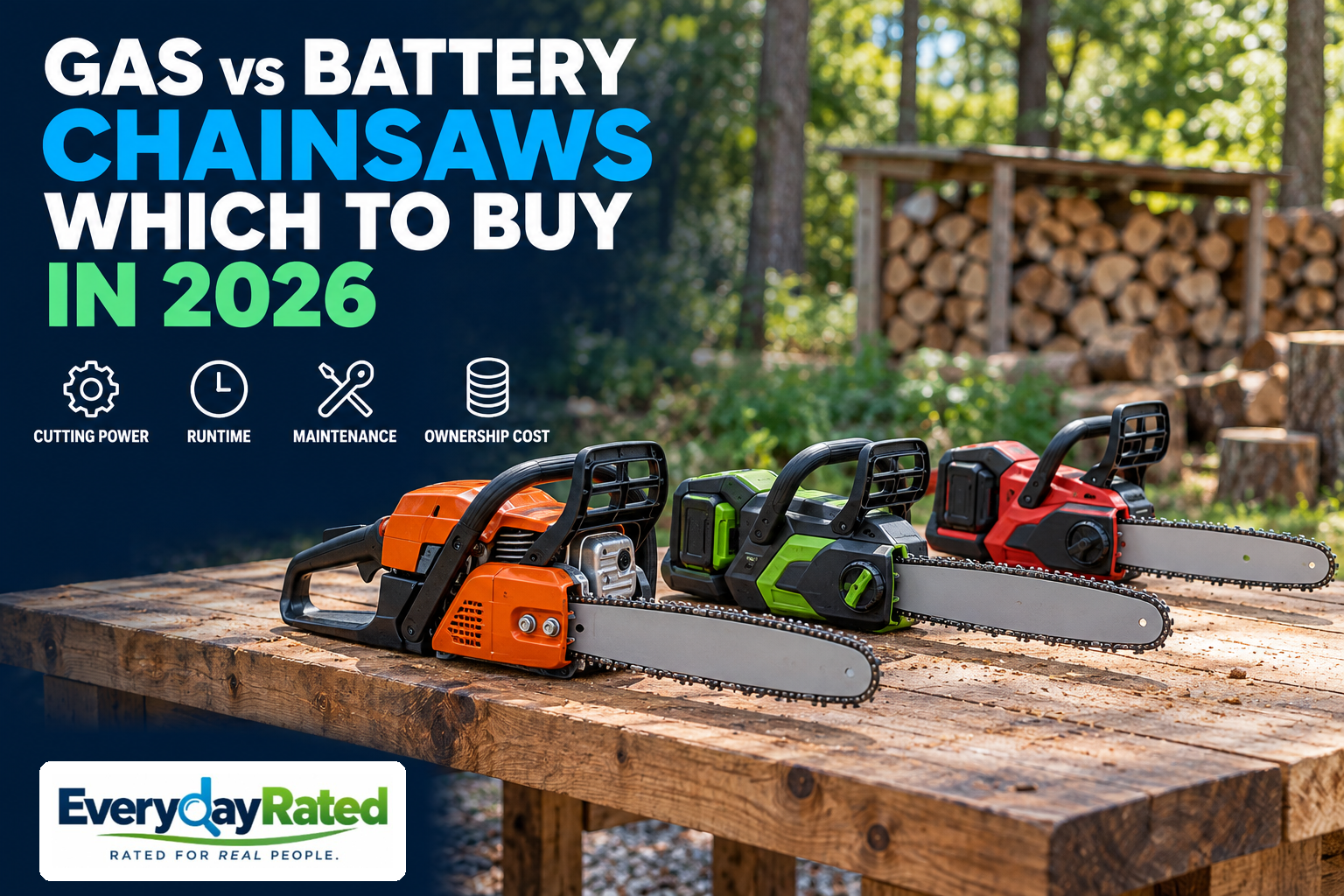
For most homeowners doing occasional ground-level cleanup, a battery chainsaw is the easier tool to own. For repeated firewood cutting far from charging, gas remains a practical choice. Our Best Overall homeowner pick is the EGO CS1815; the Husqvarna 450S Rancher is our gas choice for sustained work, and the Milwaukee 2727-21HD suits existing M18 owners.
The right question is how much cutting you need to finish between breaks. A saw that makes one fast cut may still be the wrong purchase if its working weight, battery supply or storage routine does not suit you. This guide compares ownership as well as cutting capability, with U.S. models and prices.
Affiliate disclosure: EverydayRated may earn a commission from qualifying purchases, at no additional cost to you. Our recommendations are based on independent research and product specifications. Affiliate relationships do not determine our rankings.
Quick Answer: Gas or Battery?
Choose battery for intermittent yard jobs, convenient starts and access to charging. Choose gas for frequent remote cutting when carrying fuel is more practical than carrying and recharging several packs. Choose neither yet if the job involves damaged trees, overhead work or cuts beyond your training.
EGO CS1815
4.2 / 5
Routine ground-level yard cleanup and occasional firewood, especially in an EGO household
Midrange kit; local fulfillment varies
Husqvarna 450S Rancher
4.1 / 5
Frequent firewood and property work away from convenient charging
Midrange gas saw; check the current offer
Milwaukee 2727-21HD
4.0 / 5
M18 users with suitable high-output packs who want a rear-handle yard saw
Midrange kit; check the current offer
How We Evaluated
Last Reviewed: October 2026. These are research-based editorial ratings, not EverydayRated hands-on measurements. Our scope is rear-handle saws for homeowners and property owners, rather than climbing saws or full-time logging equipment.
We weighed task-appropriate cutting capability and evidence (30%), starting and adjustment usability (25%), energy supply and ownership value (25%), and maintenance, service access and reliability evidence (20%). Scores express judgment on a five-point scale using those factors; they are not calculated from comparable laboratory measurements. No adequate failure-rate data supports a reliability ranking.
We checked current U.S. product configurations, seller prices, warranty pages, original cutting tests and model-specific safety information. Tests of older EGO saws are identified as older hardware. Published tests of larger EGO, STIHL and Milwaukee saws inform the category discussion, without transferring their times to the three picks here. [8] [15]
We also considered larger battery classes such as EGO CS2005, Milwaukee 2827 and STIHL MSA 300 C-O. Their stronger-workload focus can be useful, but additional weight and system cost are not an automatic upgrade for routine yard jobs. The awards identify different buyers; the homeowner winner is not a claim to lead every workload. [8]
At a Glance
| Buying factor | Gas chainsaw | Battery chainsaw |
|---|---|---|
| Best fit | Repeated remote firewood or property work | Intermittent yard work; suitable battery system available |
| Starting | Engine starting procedure and fuel preparation | Charged pack and model-specific start controls |
| Energy supply | Fuel replenishment after safe shutdown and cooling | Spare packs, charging access and possible cooling delays |
| Routine care | Chain and bar care plus engine and fuel care | Chain and bar care plus battery care |
| Working weight | Compare with cutting equipment and fluids fitted | Compare with the intended battery installed |
| Noise and exhaust | Engine noise and local exhaust | No engine exhaust at the saw; cutting still makes noise |
| Cost to compare | Saw, fuel, two-stroke oil, servicing, chain supplies | Saw, suitable packs, charger, replacement pack allowance, chain supplies |
Power source alone does not determine cutting speed. A sharp appropriate chain, wood condition and the saw’s output under load can outweigh a headline voltage or bar length.
| Recommended model | Power / supplied bar | Checked price | Principal tradeoff |
|---|---|---|---|
| EGO CS1815 | Battery / 18 inches | Midrange kit; local fulfillment varies | Battery supply and exact-model evidence |
| Husqvarna 450S Rancher | Gas / 20 inches | Midrange gas saw; check the current offer | Fuel and engine maintenance |
| Milwaukee 2727-21HD | Battery / 16 inches | Midrange kit; check the current offer | Best value depends on existing M18 ownership |
1. EGO POWER+ CS1815 18-inch Kit
EverydayRated Score: 4.2 / 5
Key Specifications: 56V platform; 18-inch bar; included 6.0Ah battery and 320W charger; tool-free tensioning; speed controls
The CS1815 is our default recommendation for a homeowner who needs a capable saw for a series of manageable jobs rather than a full day of production cutting. It starts without fuel mixing or a pull cord, and the included battery makes it a complete starting point for a buyer entering the EGO platform. An existing EGO owner should also compare the CS1810 bare tool, but only after checking whether their batteries suit the planned workload.
EGO specifies an 18-inch bar, a 6.0Ah pack and a 320W charger for this kit. The published motor rating is 2,500W, with chain speed up to 22 m/s. Its gas-equivalence label is a manufacturer claim, not proof of equal output under every load. Tool-free chain adjustment, a battery display and speed selection are the useful practical features here. [1]
Model identification deserves attention. CS1815 is the kit for the newer CS1810 saw; CS1804 contains the older CS1800. TechGearLab found strong performance and convenient tensioning on the older saw, but those results do not establish the newer model’s measured endurance or reliability. We did not find a sufficiently strong exact-model independent comparison to declare the CS1815 faster than our gas pick. [15]
For short sessions, the buying case is convenience. You can finish one area, set the saw down safely, move debris, and return without restarting an engine. That workflow matters more for many households than the fastest possible crosscut. Plan battery capacity around the whole job, however: frequent thick hardwood cuts can make a second pack more useful than another display feature.
The checked Lowe’s listing showed mixed pickup, shipping and delivery cues. EGO’s configuration page also displayed “Coming Soon.” Confirm local checkout availability and the exact kit before buying. Residential coverage is listed as five years for the tool and three for the battery, subject to the warranty conditions. [1] [2] [9]
Choose it if your work naturally includes breaks and charging is accessible. Choose gas if your main problem is repeated large cuts in a remote location. The CS1815’s score rewards its complete kit and useful controls, while holding back for uncertain exact-model test evidence and the potential cost of spare batteries.
Pros
- Complete battery-and-charger starting kit
- Convenient tensioning and visible battery status
- Fits the EGO 56V outdoor tool platform
Considerations
- Exact current-model independent test evidence is limited
- Spare packs add cost and carrying weight
- Retail fulfillment must be confirmed locally
Why We Picked It
The most balanced starting point for ordinary homeowner jobs where easy preparation and intermittent use matter more than uninterrupted production.
2. Husqvarna 450S Rancher 20-inch
EverydayRated Score: 4.1 / 5
Key Specifications: 50.2cc two-stroke engine; 20-inch supplied bar; 50:1 fuel mix; side chain adjustment; captured bar nuts
The 450S Rancher makes sense when the saw is a regular working tool and recharging would interrupt the task. Our preference for gas in that situation is about the supply plan: carry suitable fuel and keep working after safe cooling and refueling breaks. A battery saw can also support long sessions with enough packs and chargers, but that is an additional investment and a system to organize.
This recommendation is specifically the current 450S Rancher, not every product advertised as a “450 Rancher.” Husqvarna’s U.S. configuration includes a 20-inch bar and a 50.2cc engine rated at 3.2 hp. It specifies 50:1 two-stroke lubrication. Check the precise model on a retailer’s box before comparing a discount on an older 450 with the price here. [3]
Its appeal is straightforward ownership. Side-mounted tensioning and captured bar nuts are useful when chain adjustment is part of the workday. A documented parts and manual portal gives an owner somewhere to start when consumables or servicing are needed. Before purchase, identify a nearby servicing dealer and ask about routine maintenance charges; a brand badge alone does not establish convenient service. [3] [4]
The tradeoff arrives whenever the saw sits unused. Fuel selection, storage and engine care become part of the ownership routine. You also need to budget for engine consumables and keep the starting procedure familiar. Someone who cuts a few branches twice a year may find those obligations harder to justify than the saw’s ability to accept another tank of fuel.
The manufacturer showed online ordering; check the current offer. Residential limited coverage is two years, with a conditional extension advertised for qualifying fuel purchases and registration. That extension is not automatic, and wear items are excluded. Read the applicable terms before treating an extended warranty as part of the price. [3]
We have not established an exact-model independent head-to-head against the CS1815. The 450S earns its award for its fit with sustained, off-grid work and its documented service provisions. Its 4.1 score also reflects the extra fuel and maintenance work. If you routinely work near the limits of a 20-inch bar in dense hardwood, ask a qualified dealer about a larger class rather than assuming this midrange model is a professional logging saw.
Pros
- Fuel replenishment suits extended remote work
- Conventional bar adjustment with captured nuts
- Manufacturer parts, manuals and dealer service pathway
Considerations
- Fuel mixing and engine upkeep require attention
- Starting and seasonal storage add steps
- This is a midrange property saw, with limited exact-model comparative evidence
Why We Picked It
A practical gas choice for buyers whose workload makes repeated recharging or a large spare-battery inventory inconvenient.
3. Milwaukee M18 FUEL 2727-21HD 16-inch Kit
EverydayRated Score: 4.0 / 5
Key Specifications: M18 platform; 16-inch bar; 12.0Ah kit battery; rapid charger; dual-stud retention; automatic oiler
The strongest reason to choose this Milwaukee is the equipment you already own. Sharing suitable batteries and chargers can be more useful than buying into a second platform for one saw. The 2727 is our platform-specific alternative, while the EGO kit remains the broader homeowner recommendation. At a similar new-kit price, Milwaukee is less compelling for a buyer with no existing M18 equipment.
The kit includes the rear-handle 16-inch saw, a 12.0Ah pack and a rapid charger. It has two studs securing the bar and an automatic oiler. Although it accepts M18 batteries, Milwaukee recommends higher-output packs for the best power and runtime. Compatibility with a small drill battery should not be mistaken for equal performance. [5]
There is useful original testing for the 2727. In 2018, OPE Reviews reported 100 crosscuts in six-inch oak with battery reserve remaining, then several more cuts in a substantially larger trunk. Its comparison also beat a gas saw in that particular sequence, but the chains differed in condition. Those results support real cutting ability; they do not establish a universal battery-versus-gas winner or current battery-pack endurance. [7]
Kit contents need a final check. Milwaukee’s current page shows a HIGH OUTPUT HD12.0 pack in its contents while parts of the description refer to FORGE. Ask the seller which battery SKU will ship. That matters to the value calculation, even though either label may appear beside the same kit number. Check the current Home Depot offer; local availability and promotions can change. [5] [6]
This is the single-battery 2727 family, not Milwaukee’s larger dual-battery 2827. It is also separate from the 2826 top-handle family named in a chain-brake safety notice. Use the exact model and serial number when checking safety notices. Milwaukee’s outdoor equipment warranty is three years, with separate battery coverage; do not assume its general five-year power-tool warranty applies. [10] [13]
Buy it for platform sharing and a familiar conventional bar mount, rather than a promise that 18V defeats every higher-voltage saw. If your existing packs are all small capacity, compare the full price of a larger pack and charger with a complete competing kit. Its 4.0 score recognizes established cutting evidence and platform usefulness, with deductions for new-platform value and current kit-content ambiguity.
Pros
- Useful battery sharing for established M18 owners
- Original cutting evidence for the 2727 saw family
- Conventional dual-stud bar retention
Considerations
- Small M18 packs are a poor basis for demanding runtime expectations
- Current battery descriptions require seller confirmation
- Less attractive as a new platform at the checked kit price
Why We Picked It
A sensible addition for M18 owners with the right batteries, supported by original testing of the saw family rather than voltage alone.
Buyer’s Guide: Four Decisions That Matter
1. Match the saw to the wood and your working limits
Write down the size and type of material you usually cut, how often you cut it, and how far it is from power. A property with many trees does not automatically require gas if cutting is infrequent. Conversely, a small property can produce a demanding firewood task. Choose for the recurring job, and hire help for the unusual dangerous one.
Bar length describes the cutting equipment, not the engine or motor’s ability to drive it through every type of wood. Longer bars also change handling. Use only approved combinations for the saw, and prioritize a controllable working weight over the biggest specification. Hold a display model with the intended battery or comparable operating setup before committing.
Do not rank saws by voltage. Motor design, battery output, chain geometry and speed under load all matter. In Pro Tool Reviews’ test of larger battery models, the highest gas-equivalence claim did not produce the fastest small-log cutting sequence. That illustrates why one specification cannot replace a task-specific test; it does not predict the results of our three recommendations. [8]
2. Budget for energy supply, not an advertised cut count
An “up to” cut count belongs to a particular battery, wood dimension and test setup. EGO’s small-lumber claims and Milwaukee’s claims are not a common test. Do not convert them into a promise for hardwood rounds, or choose the larger advertised number as the endurance winner. Neither minutes of trigger time nor a tank count tells you how long an entire cleanup will take.
For battery work, ask whether the kit can finish your ordinary job, whether a second pack is affordable, and where it will recharge. Consider the charger’s requirements and the manufacturer’s temperature limits. A spare charged battery can help; it does not guarantee continuous work if cutting consumes energy faster than your charging system replaces it.
For gas, include approved fuel containers, the correct fuel mixture and safe cooling breaks. Refueling is not immediate on a hot saw: OSHA says not to fuel a running or hot engine. During an outage, charged batteries provide a finite reserve while gas requires an available fuel supply. Plan either system before the emergency. [11]
3. Compare the complete ownership cost
Compare kit with kit. A bare battery saw price excludes the very parts that make it usable, while a gas saw still needs fuel, lubricants and maintenance supplies. Both need bar-and-chain oil, replacement chains, sharpening supplies and protective equipment. Battery means less engine work, not a maintenance-free chain.
Use this worksheet: purchase price + missing battery/charger or fuel equipment + spare energy supply + chain supplies + expected service and replacement costs. Add the current kit price and any spare-pack cost before shared consumables. A gas saw is not cheaper or dearer over its life until usage and service costs are included.
An existing platform can change the result substantially, but count only batteries that actually suit the saw. Avoid assuming a pack bought for a drill or light will give demanding chainsaw performance. Check separate tool and battery warranties, authorized sellers and local service options. Warranty duration is coverage information, not a measured service-life prediction.
4. Make maintenance and safe handling part of the purchase
Follow the exact manual for chain tension, oiling, sharpening, cleaning and storage. Stop and investigate declining performance rather than forcing the saw harder. Before adjustments, shut down a gas saw or remove the battery as the manual requires. Keep the chain brake and other safety controls functional; do not treat them as permission to take risky cuts.
Both power sources can kick back and cause severe injury. Use appropriate head, eye/face, hearing, hand, foot and chainsaw-rated leg protection, selected for the saw type. Keep both hands on the handles, maintain firm footing and keep the bar tip clear of unintended contact. A quieter motor does not eliminate hearing protection or other protective equipment. [11]
Storm-damaged trees can contain hidden tension and unstable limbs. CDC specifically highlights the increased risk during disaster cleanup. Leave hanging trees, work near power lines, climbing, ladder work and unfamiliar felling to qualified help. No purchase recommendation here is a cutting tutorial or a recommendation to work beyond your training. [12]
Common Questions
Are battery chainsaws as powerful as gas?
Some battery models have genuine cutting capability comparable with gas models for particular jobs, as original testing shows. Equal performance across all loads and equal endurance are separate questions. Compare specific saws, batteries and test conditions rather than assuming every battery saw is weaker or every gas-equivalence claim is conclusive.
[7] [8]Do battery chainsaws still need oil?
Yes. They need the specified bar-and-chain lubricant even though there is no gasoline engine mixture. Follow the reservoir and maintenance instructions for the exact saw.
[5]Is battery always lighter or safer?
No. Use working weight with the chosen battery installed, and assess handling. Both types require training and protective equipment. Power-source convenience is not a safety certification.
[8] [11]Should I replace a working gas saw?
Only if the convenience and upkeep savings justify the cost for your actual use. Keeping a serviceable gas saw for long jobs and adding battery for frequent short jobs can make sense, but maintaining two systems is unnecessary for many households. For a handful of small branches, a manual pruning saw may be enough.
Plan the Rest of Your Yard Tool System
Battery sharing is most useful when it fits the rest of your outdoor equipment. Browse our Home & Yard buying guides for the current mower and leaf-blower guide listings before choosing another battery platform.
EverydayRated Verdict
Battery wins for most intermittent homeowner jobs; gas remains the practical choice for repeated remote cutting. The EGO CS1815 is our Best Overall homeowner option because the complete kit combines useful adjustment and control features with a convenient battery workflow.
Choose the Husqvarna 450S Rancher when a sustained workload makes fuel replenishment more practical than assembling a large battery supply. Choose the Milwaukee 2727-21HD when you already own suitable M18 equipment and prefer its conventional bar mount. Buyers starting from scratch should compare complete kit costs rather than brand loyalty.
You may not need either saw for occasional small pruning, and a saw purchase cannot make a dangerous tree-removal job suitable for DIY. The final purchasing check is simple: confirm the exact model, working weight, energy supply, seller’s kit contents and service options before paying.
Sources & Research
Research reviewed in October 2026. Manufacturer specifications and claims are distinguished from original third-party testing; older models and battery configurations are identified where relevant.
- EGO CS1815 / CS1810 — current specifications and kit configuration
- Lowe’s — exact EGO CS1815 6.0Ah kit, listed price and location-dependent fulfillment
- Husqvarna 450S Rancher — U.S. product, price, fuel and residential warranty
- Husqvarna 450S Rancher — manuals, parts and support
- Milwaukee 2727-21HD — kit, battery recommendations and chain maintenance
- Home Depot — Milwaukee 2727-21HD kit and listed price
- OPE Reviews — original 2018 Milwaukee 2727 cutting and runtime test
- Pro Tool Reviews — original comparison of larger EGO, Milwaukee and STIHL battery saws
- EGO — current limited warranty policy
- Milwaukee — outdoor power equipment and battery warranty terms
- OSHA — Chainsaw Safety QuickCard
- CDC — chainsaw safety during disaster cleanup
- Milwaukee — safety notice for specific 2826 top-handle saws
- EverydayRated — verified Home & Yard guide index
- TechGearLab — original tests of the older EGO CS1800, not CS1810