
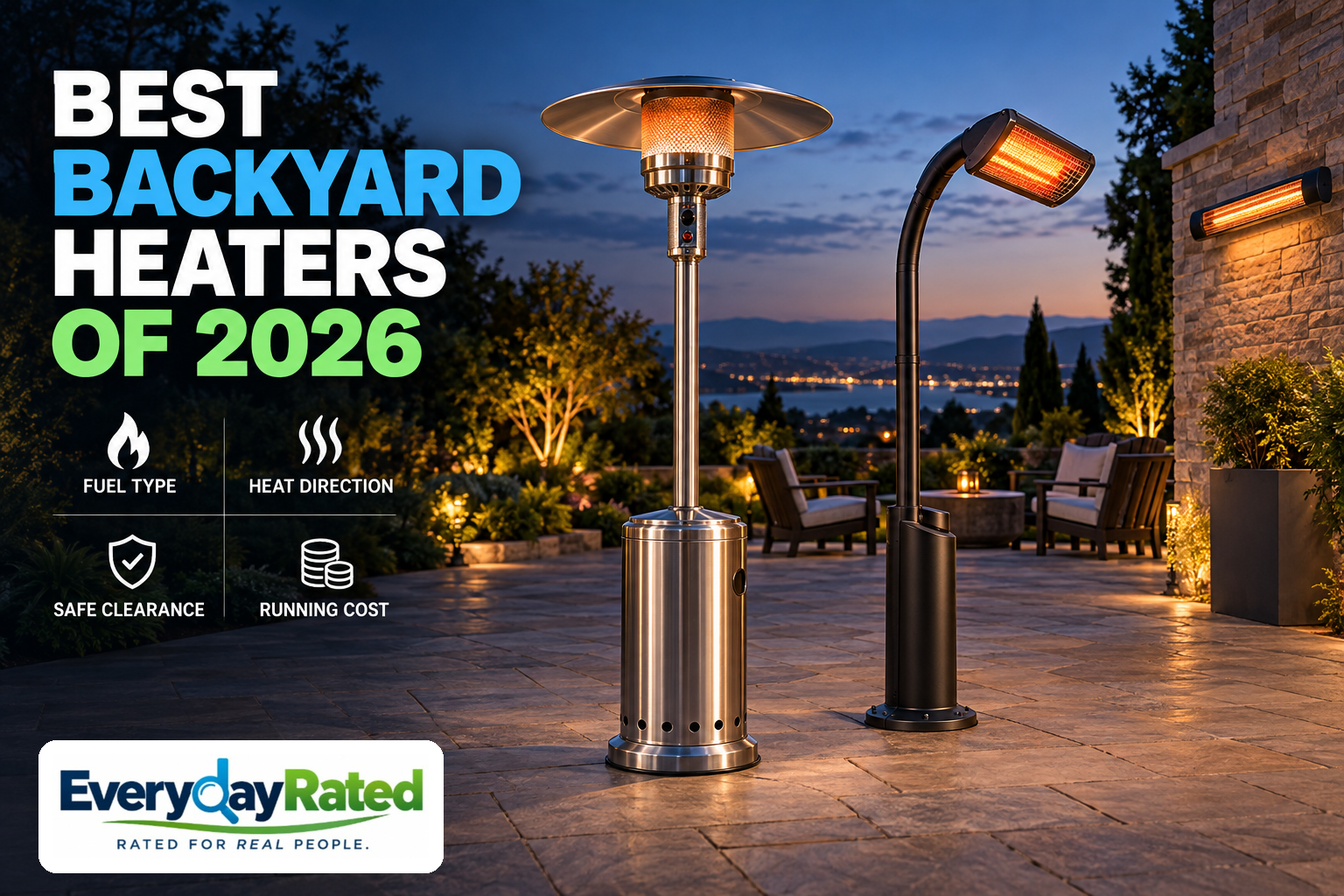
A backyard heater should make a particular place comfortable: the dining table, a pair of lounge chairs or the spot where guests gather. Our Best Overall choice for an open patio is the Hampton Bay NCZH-G-SS. Choose the Dr. Infrared DR-238 for inexpensive electric warmth in a small seating zone, or the Bromic Tungsten BH0510001 for premium directional propane heating.
This guide compares U.S. patio heaters for residential outdoor use. We considered placement, heat delivery, purchase cost, fuel or electricity requirements and the strength of the available evidence. These recommendations do not promise to turn an exposed backyard into an indoor room.
Affiliate disclosure: EverydayRated may earn a commission from qualifying purchases, at no additional cost to you. Our recommendations are based on independent research and product specifications. Affiliate relationships do not determine our rankings.
Quick Answer
For an open patio with a movable gathering area, start with Hampton Bay. For a fixed seat near an approved electric mounting point, choose Dr. Infrared. Consider Bromic when directional propane heat fits the layout and frequent use makes its premium worthwhile.
Hampton Bay NCZH-G-SS
4.2 / 5
Occasional outdoor gatherings with room for a tall propane heater
Budget-oriented; local offers and stock vary
Dr. Infrared DR-238
4.1 / 5
A small, sheltered seating zone with an approved mounting position and suitable outlet
Budget-oriented; compare current retailer offers
Bromic Tungsten BH0510001
4.0 / 5
Frequent patio users who can justify a premium to direct heat toward a defined group
Premium; check Woodland Direct’s current offer
How We Evaluated
Last Reviewed: October 2026. These are EverydayRated research-based editorial assessments, not hands-on test results. We reviewed current model identifiers, store listings, manuals, warranty information and original third-party outdoor tests.
Our consistent rubric weighs useful heat delivery and supporting evidence (35%), placement and usability (25%), total ownership value (25%), and documented construction, maintenance and support (15%). Scores summarize editorial judgment on a five-point scale; they are not outputs from a comparable laboratory dataset. There is insufficient failure-rate evidence to rank long-term reliability.
We distinguish original testing from roundup recommendations and manufacturer claims. TechGearLab’s older comparison informs realistic expectations; model-family findings are identified where current SKU identity is uncertain. Safety features mentioned by a reviewer do not replace the exact manufacturer instructions. Exact-model recall searches did not surface a matching notice, but this is not a guarantee that a heater is recall-free; check the model and serial number before use. [5] [11]
We also considered EAST OAK TORCH, Amazon Basics 46,000 BTU, Hiland and pyramid flame-tube heaters. EAST OAK’s direct listing showed sold out for the displayed variant. The others do not offer a sufficiently clear combined advantage in exact-model evidence, current purchase verification and fit to displace this shortlist. A decorative flame can be a valid priority, but it is not proof of better heat delivery. [10]
At a Glance
| Buying factor | Hampton Bay NCZH-G-SS | Dr. Infrared DR-238 | Bromic Tungsten BH0510001 |
|---|---|---|---|
| Power and output | Propane, up to 48,000 BTU/h | Electric, up to 1,500W (about 5,118 BTU/h) | Propane, up to 38,500 BTU/h |
| Placement | Freestanding, all-around gathering area | Approved wall/ceiling mounting, aimed at a small zone | Freestanding, directional tilting head |
| Main added costs | Cylinder, fuel, cover | Mounting and any electrical work | Cylinder, fuel, cover, possible freight/service costs |
| Key limitation | Clearances, wind and bulky storage | Short warm zone outdoors | Very high price; limited comparative evidence |
BTU/h and watts express heat rate, not a guaranteed comfortable radius. The electric conversion is arithmetic (1W ≈ 3.412 BTU/h), not a test of how much heat reaches a particular chair. Prices above are listing snapshots; confirm local fulfillment and checkout totals.
1. Hampton Bay NCZH-G-SS 48,000 BTU Stainless Steel Patio Heater
EverydayRated Score: 4.2 / 5
Key Specifications: Up to 48,000 BTU/h; 20 lb propane cylinder sold separately; approximately 87 in tall; wheels; variable control; anti-tilt device
For an ordinary open backyard patio, this Hampton Bay offers the most sensible balance of purchase cost, movable placement and adjustable propane output. Our recommendation is specifically model NCZH-G-SS on Home Depot listing 318485576. The same model designation appears on other listings with different prices and descriptions, so compare the listing as well as the name. [1]
The attraction is flexibility. Place the heater where your group actually gathers, provided the manual’s clearances and surface requirements are met. Wheels help with repositioning after shutdown and cooling; they do not make moving a running heater acceptable. For a renter or occasional host, avoiding permanent electrical or gas installation can be worth more than premium controls.
TechGearLab’s older comparison found a Hampton Bay 48,000 BTU stainless heater straightforward to use, but its product description does not establish that every detail matches the current wheeled listing. We use that as family-level context, not an exact-unit performance certification. We have no independent cold-weather heat-radius measurement for this particular current SKU. [5]
The seller’s specifications advertise 215 square feet of coverage, while a headline bullet says 245 square feet. Treat that as a planning claim, not a promise that everyone across that area will feel comfortable. Wind, air temperature and where people sit change the result. Start with one compact gathering area; buying a tall heater to warm a large, exposed yard is likely to disappoint. [1]
Ownership includes the cylinder, fuel, a suitable cover and seasonal inspection. The listing states a one-year manufacturer warranty. That is useful coverage information, not proof of a one-year lifespan or a measured durability advantage. Save the receipt and exact manual, and confirm the current parts-support contact before the return window closes. [1] [2]
Its 4.2 score rewards practical output, adjustable heat and a low entry cost. It loses points for fuel handling, bulky storage and limited exact-SKU comparative evidence. Buy it when you can provide a suitable outdoor location and expect several people to gather nearby. A fixed two-chair nook with a suitable outlet may be better served by our electric pick.
Pros
- Movable propane setup avoids a permanent utility installation
- Adjustable output and wheeled base
- Accessible entry price for occasional patio use
Considerations
- Needs cylinder, recurring propane purchases and storage space
- Advertised coverage is not independently verified for this SKU
- Requires substantial clearances and attention to weather
Why We Picked It
The strongest general-purpose value for an open patio in this shortlist; 4.2 reflects useful heat capacity and affordability balanced against fuel and placement obligations.
2. Dr. Infrared Heater DR-238 1500W
EverydayRated Score: 4.1 / 5
Key Specifications: 120V; 900/1,200/1,500W settings; infrared element; remote; wall/ceiling brackets; one-year limited component warranty
The DR-238 makes the most sense when you know exactly where people will sit. Instead of placing a tall propane appliance beside the group, mount this electric infrared bar in an approved position and aim warmth toward the seating. Its low purchase price and simple power settings make it our value choice for a small zone, rather than a substitute for a large patio heating installation.
Dr. Infrared lists three settings—900, 1,200 and 1,500 watts—a remote and included wall or ceiling mounting brackets. The direct store showed an Add to Cart option; compare the current offer with Northern Tool’s listing for the same model. Mounting labor or electrical work can change the total even when the heater itself is inexpensive. [3] [12]
In TechGearLab’s December 2023 test, the 1,500W Dr. Infrared heater was most comfortable within about three feet in subfreezing weather. The reviewers also encountered inconsistent remote operation that improved with fresh batteries. That test is useful evidence for localized warmth, not support for a large outdoor coverage promise. Its tested mounting arrangement should not override the installation directions for the unit you receive. [5]
The documentation deserves care. Current store copy uses broad weatherproof language, while circulated manuals and revisions differ in how they describe acceptable exposure. Follow the manual supplied with your exact unit and obtain manufacturer confirmation if the location will receive direct rain. Do not infer that an outdoor rating authorizes every wet location, orientation or mounting height. [3] [4]
At full power, the arithmetic is transparent: 1.5 kilowatts multiplied by your electricity price per kilowatt-hour gives an hourly energy cost. At an illustrative $0.20/kWh, that is $0.30 per hour, before any fixed charges. It is inexpensive only when the warm zone matches the job; running an inadequate heater longer does not expand its comfortable reach.
The manual provides a one-year limited component warranty. Our 4.1 score recognizes price, selectable output and useful independent evidence of close-range comfort, while accounting for the narrow warm zone and installation constraints. It is a good buy for a regular seat near a suitable mounting point. Skip it if you want people to circulate freely across a large patio. [4]
Pros
- Low purchase cost and no propane refills
- Three output levels and remote control
- Mounted design can preserve usable floor area
Considerations
- Comfortable outdoor reach can be short in cold conditions
- Needs proper mounting and a suitable electrical supply
- Weather-exposure instructions need exact-unit confirmation
Why We Picked It
A focused, inexpensive solution for a small seating area. Its 4.1 score reflects localized usefulness rather than a claim to match propane output.
3. Bromic Tungsten Smart-Heat Freestanding / Portable LP BH0510001
EverydayRated Score: 4.0 / 5
Key Specifications: LP model BH0510001; up to 38,500 BTU/h; tilting directional head; built-in wheels; 20 lb cylinder recommended; approximately 85 in high
Bromic is the specialist choice for a seating layout that benefits from directional heat. Its curved support and adjustable head let the emitter face the group, rather than distributing warmth around a conventional mushroom reflector. That difference can justify the price for a frequently used outdoor lounge, but it is a substantial investment for a handful of evenings each year.
Bromic’s current site calls the product Tungsten Smart-Heat Freestanding; many sellers retain the Portable name. The recommended liquid-propane version is BH0510001. BH0510005 is the natural-gas version and requires a different fuel arrangement. Check the fuel suffix before paying; the presence of wheels does not make the natural-gas model a cylinder heater. [6]
The published maximum is 38,500 BTU/h, with a catalog height of about 85 inches. The manufacturer specifies a tilting head and built-in wheels. These are relevant design features, but they do not establish that a lower-BTU heater always produces more comfort than a higher-BTU competitor. Distribution and conditions matter alongside the number on the label. [6] [7]
Bromic advertises approximately 215 square feet of heating and resistance to winds up to eight miles per hour. Those are manufacturer claims. We did not locate a strong independent exact-model comparison that verifies its premium over the other recommendations. We therefore do not use the brand’s efficiency multiplier as a demonstrated fuel-saving result. [6] [7]
Woodland Direct showed the LP model with ordering and freight-shipping information. The optional cover adds cost. Bromic’s warranty document lists one-year parts coverage for Tungsten Portable, with owner responsibilities and exclusions; confirm applicable U.S. terms with the selling dealer. A high purchase price should not be mistaken for comprehensive long-term labor coverage. [8] [9]
Its 4.0 score recognizes a purposeful directional design and documented support materials, while heavily accounting for cost and limited independent comparative evidence. The premium award identifies a different buyer priority, not a higher overall score. Before ordering, ask for a layout assessment and confirm that the seating, clearances and storage route suit the heater.
Pros
- Tilting head directs warmth toward a particular seating zone
- Wheels and modular construction support repositioning and storage
- Clearly identified propane and natural-gas variants
Considerations
- Costs far more than either mainstream pick
- Premium performance claims lack a strong independent exact-model comparison
- Fuel, cover and service-related costs remain relevant
Why We Picked It
A deliberate choice for buyers who value directional placement enough to pay for it. Its 4.0 reflects that narrower value case and the evidence limits.
Buyer’s Guide: Four Decisions That Matter
1. Map the seating before comparing output
Measure the space people actually occupy, the overhead clearance and nearby combustible surfaces. Then identify a safe heater position that preserves walkways. A high output specification is irrelevant if the only available location cannot meet the manual’s requirements. Include the heater’s reflector and required clear zone, not just its small base.
All-around heating makes sense for people gathered around a central point. Directional infrared heat suits seating arranged to one side. Neither configuration is inherently best for every yard. A heater behind one guest may leave another guest cold, even when both chairs sit inside a marketing coverage diagram.
Wind and low temperatures reduce the usefulness of optimistic coverage claims. Compare original tests only with their conditions attached. For an exposed site, first decide whether you would enjoy sitting there at all on the nights you hope to use it. Better clothing or choosing milder evenings can be more sensible than buying multiple heaters.
2. Choose the fuel supply you can live with
Propane lets you place a heater without a power cord, but the cylinder must be bought or supplied, filled and handled correctly. Plan a safe place for storage and a practical refill routine. A spare cylinder can avoid interrupting a gathering, but it also adds another item to store according to the instructions and local requirements.
A 1,500W plug-in heater draws approximately 12.5 amps at 120V. Check the circuit capacity and any other connected loads; having two sockets does not establish two independent circuits. Follow the supplied manual on outlet protection and cord use. Have a qualified electrician resolve an unsuitable outdoor supply instead of improvising an extension arrangement. [4]
More powerful electric systems may need a different voltage, dedicated wiring and professional installation. Their installed cost belongs in the comparison. A natural-gas connection can remove cylinder refills, but changes placement flexibility and installation work. Purchase the correct fuel version rather than assuming a propane unit can be converted.
3. Calculate cost per evening, not just the sticker price
For electric heat, multiply the selected kilowatts by hours used and your energy rate. A 1.5kW unit used for three hours at an illustrative $0.20/kWh costs $0.90 in electricity. Fifty such evenings cost $45. Your actual tariff may differ, and mounting or circuit work is additional.
For propane, divide your actual refill cost by the runtime you obtain at your usual setting. As a purely illustrative budget, a $25 fill lasting eight hours is about $3.13 per hour, or $9.38 for three hours. This is not a measured runtime or current propane price for any recommended model. Do not compare that scenario with a manufacturer’s longest low-setting runtime as though conditions were identical.
Include missing accessories, storage, maintenance and likely service access. An inexpensive heater used a few times can be enough; a frequently used patio can justify a better-directed system. Premium styling, a remote or a visible flame is worth paying for only when it improves the experience you actually want.
4. Read the manual before committing to the location
Outdoor propane heaters need the ventilation and combustible clearances specified for the exact appliance. Never use one in a home, garage, tent or other enclosed space. A roof and open sides do not automatically establish an approved covered-patio installation. Follow the current manual and applicable local requirements; a generic internet clearance number is not enough. [2]
Assemble and ballast the unit as instructed, inspect it before use, and perform the prescribed gas leak checks. Turn it off and let it cool before moving or covering it. Keep people, pets and movable furnishings clear of hot surfaces. An anti-tilt switch is a backup feature, not permission to operate in gusts or leave the heater unattended. [2]
For mounted electric units, confirm the approved height, orientation, mounting surface and exposure rating. A glowing element can burn even without an open flame. Inspect cables and mounts and follow cleaning instructions. Keep the receipt, model and serial number accessible for support and recall checks. [4] [11]
Related Buying Guides
Preparing the patio for colder months also means planning safe access and clearing snow when needed. See our best snow shovels of 2026 for small paths, or our snow blower buying guide for larger areas. Clear and inspect the heater location before operation.
EverydayRated Verdict
The Hampton Bay NCZH-G-SS is our Best Overall choice for an open backyard patio because its practical propane configuration, movable placement and accessible price fit occasional gatherings well. It is a balanced purchase recommendation, not a claim that we measured the widest heat radius.
Choose Dr. Infrared DR-238 when you have a small, fixed seating area and a suitable electric mounting location. Choose Bromic BH0510001 when directional propane heat suits your layout and frequent use makes a premium design worthwhile.
You may not need any patio heater if you rarely sit outside in cool weather, lack an approved location, or expect to make a windy yard feel like an indoor room. The most important final check is the layout: confirm the exact model’s clearances, fuel or power supply, and where the people will sit before buying.
Sources & Research
Reviewed October 2026. Seller prices and fulfillment can change. Manufacturer output and coverage claims are identified as claims; third-party tests are dated and their scope is stated.
- Home Depot — Hampton Bay NCZH-G-SS, Internet #318485576, specifications and purchase listing
- Hampton Bay — NCZH-G-SS use and care guide
- Dr. Infrared — DR-238 direct-store specifications and purchase listing
- Dr. Infrared — DR-238 owner’s manual and component warranty
- TechGearLab — original outdoor-heater testing, updated December 2023
- Bromic — Tungsten Smart-Heat Freestanding, formerly Portable
- Bromic — U.S. catalog with BH0510001 output and dimensions
- Woodland Direct — Bromic Tungsten Portable LP purchase listing
- Bromic — warranty document supplied by distributor
- EAST OAK — TORCH 48,000 BTU competing heater and availability
- CPSC — recall search
- Northern Tool — DR-238 alternate purchase listing and warranty