
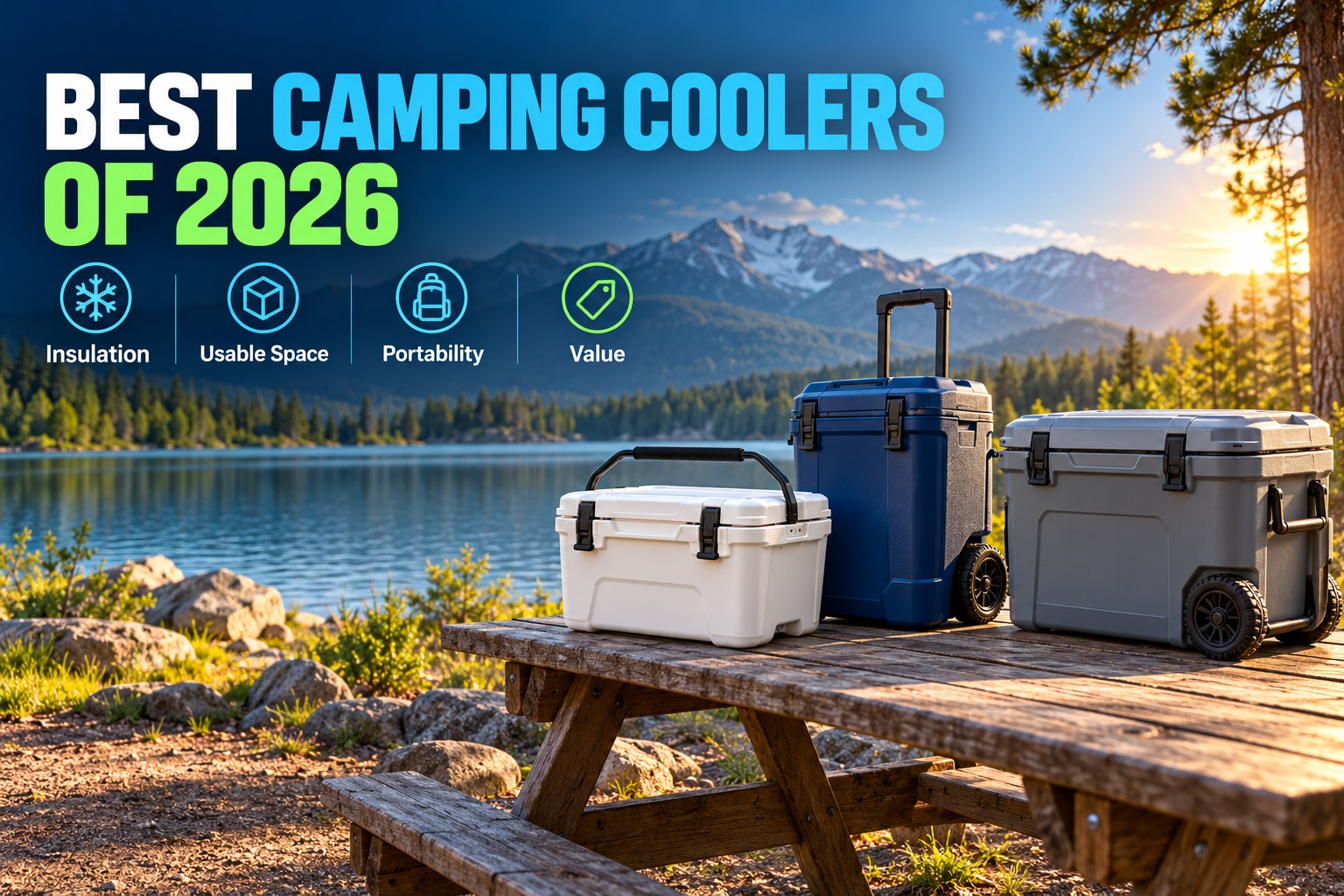
The best camping coolers of 2026 should keep the food cold without making the walk to camp a team-building exercise. Our Best Overall for Car Camping is the RTIC 52 QT Ultra-Light. Choose the Coleman Classic 65 Wheeled for occasional trips on a tighter budget, or the YETI Roadie 48 when premium rolling convenience is worth the extra cost.
This guide compares U.S. hard-sided ice coolers for drive-in camping, picnics and road trips. It does not rank electric refrigerators or backpacking soft coolers. We evaluated insulation evidence, usable packing space, carrying and rolling, hardware and ownership value. EverydayRated has not physically tested these products.
Affiliate disclosure: EverydayRated may earn a commission from qualifying purchases, at no additional cost to you. Our recommendations are based on independent research and product specifications. Affiliate relationships do not determine our rankings.
Quick Answer
Choose RTIC for a short carry and insulation value. Choose Coleman for occasional, budget-conscious trips over firm paths. Choose YETI when frequent rolling and extra cold-holding margin justify the premium. A thermometer and realistic packed weight belong in every plan.
RTIC 52 QT Ultra-Light
4.4 / 5
Campers who can carry a loaded chest and want insulation value
Midrange; $229 checked in Navy
Coleman Classic 65 Wheeled
4.2 / 5
Occasional weekend campers and buyers rolling over firm paths
Budget; $84.99 checked, Twilight SKU 2182647
YETI Roadie 48
4.5 / 5
Frequent campers who value rolling convenience and added insulation margin
Premium; $425 checked
How We Evaluated
Last Reviewed: October 2026. Product and purchase pages checked October 30, 2026. Our five-point scores are EverydayRated editorial judgments, not laboratory measurements or copied review scores.
We use the same priorities for all three: insulation evidence (35%), transport and handling (25%), usable space and everyday operation (20%), and purchase cost, warranty and support evidence (20%). These weights guide judgment; they do not turn unrelated data into a precise mathematical ranking. No comparable failure-rate dataset establishes which cooler lasts longest.
OutdoorGearLab supplies a common insulation test across all three, while CleverHiker adds a separate original RTIC assessment. Controlled results describe those samples and conditions. Ambient heat, starting temperature, packing and opening frequency change real-trip performance. Our comparison separates the 40°F threshold from a looser drink-temperature threshold. [2] [3] [6] [8]
We also reviewed the broader field, including larger Roadie and Tundra models, RTIC’s heavier hard coolers and smaller budget options. Bigger capacity or more insulation is useful only if you need it and can move it. The YETI earns our highest score, while the RTIC wins the default award because its cost better fits the stated car-camping buyer. [12]
At a Glance
| Model / score | Price snapshot | Handling and size | Insulation test: below 40°F | Main tradeoff |
|---|---|---|---|---|
| RTIC 52 QT Ultra-Light / 4.4 | Midrange; $229 checked in Navy | Carry; 21 lb listed; no wheels | 5.8 days | Loaded carrying weight; accessory costs |
| Coleman Classic 65 Wheeled / 4.2 | Budget; $84.99 checked, Twilight SKU 2182647 | Wheeled; 65-quart named model | 4.7 days | Less insulation margin; basic handles and lid |
| YETI Roadie 48 / 4.5 | Premium; $425 checked | Wheeled; 28.3 lb listed; 20.6 in high | 6.8 days | Premium price; substantial lifting weight |
U.S. prices before tax, checked October 30, 2026; offers and availability can change. Awards identify different buyers, and scores express editorial judgment. Confirm the exact model and final seller terms before ordering.
Insulation figures are OutdoorGearLab test results under its conditions, not a safe-food guarantee for your trip. [2] [6] [8]
1. RTIC 52 QT Ultra-Light Cooler
EverydayRated Score: 4.4 / 5
Key Specifications: Carry model, no wheels; 21 lb listed empty; 27.17 × 17.49 × 17.33 in exterior; basket/divider extra
The RTIC is our starting point for drive-in campers because it spends the budget on a useful insulated chest rather than a premium rolling system. Choose it when the cooler usually travels from a vehicle to a nearby table. A model that saves money in the store can become a poor purchase if every trip involves a long, awkward carry.
OutdoorGearLab recorded 5.8 days below its 40°F test threshold and 6.3 days below 50°F. It also found lid leakage when jostled and raised concerns about the flexible latches. CleverHiker separately found the cooler easy to transport for its size. These are observations from their samples, not EverydayRated measurements or promises for a hot campsite. [2] [3]
RTIC’s current listing distinguishes this carry version from the separate wheeled Ultra-Light. Its removable basket and freezable divider are sold separately. The current warranty lists three years for Ultra-Light hard coolers, subject to the original-purchaser and authorized-seller conditions. Confirm the package before comparing it with an older review that included accessories. [1] [4]
For ownership, consider the route rather than the empty weight alone. Food, containers and cooling material can make a manageable empty chest difficult to lift. If two people will carry it, check that both can grip the handles comfortably and that the packed cooler fits through the vehicle opening. Leave room to raise the lid at camp.
A carry design makes sense when you already own a suitable cart or rarely move the cooler after unloading. It makes less sense when you expect to drag it across a parking lot every weekend. Paying for wheels can be more useful than paying for another inch of insulation if transport is the task that keeps you from using the equipment.
Our 4.4 score rewards insulation evidence and a sensible purchase cost. The absence of wheels, extra-cost organizers and lid-sealing limitations keep it below the premium pick on handling. Best Overall here means the most balanced car-camping purchase for the stated buyer, rather than the highest-performing cooler at any price.
Pros
- Strong insulation result in the cited comparative test
- Lower purchase cost than the premium wheeled pick
- Three-year Ultra-Light warranty under current terms
Considerations
- No wheels; consider the fully packed carrying load
- Basket and divider add to the bill
- Test sample leaked at the lid when jostled
Why We Picked It
A balanced choice when the carry is short and insulation value matters more than a premium wheeled chassis.
2. Coleman Classic Series 65-Quart Wheeled Cooler
EverydayRated Score: 4.2 / 5
Key Specifications: 65-quart named model; telescoping handle; wheels; four lid cup holders; one-year listed warranty
The Coleman is the recommendation for someone who wants to get to camp without turning the cooler into the largest line on the receipt. Its appeal is a lower-cost combination of capacity and wheels. A buyer taking a few short trips each season should compare what the extra money for a premium model would actually change.
OutdoorGearLab’s sample stayed below 40°F for 4.7 days in its controlled test. The reviewers liked rolling it over pavement, but found the side handles uncomfortable under load, the lid unwilling to stay open and the drain vulnerable to knocks. Those limitations are more useful buying information than an unqualified claim that the cooler holds ice for days. [6]
The checked Coleman listing offered the Twilight 2182647 version with an Add to Bag control. Its page mixes can-only and food-plus-ice capacity statements; those figures describe different packing assumptions. Use the named 65-quart model and exact SKU when shopping, and confirm the physical fit instead of choosing the largest can-count badge. [5]
Think of the cooler as a piece of trip logistics. If your route is mostly pavement and the cooler can stay beside the vehicle, basic wheels may be all you need. A beach approach with deep sand, a narrow stairway or a rough campsite changes that calculation. Wheels do not remove the need to lift the chest into the car.
The tall interior may suit bottles, but your own lunch containers still need to stack sensibly. Before buying, arrange the containers you normally take, allow space for ice, and compare that footprint with the interior. Do not add enough food for a week simply because there is unused volume; choose a load you can move and keep cold.
Its 4.2 score reflects useful low-cost mobility with handling compromises and less insulation margin than the other two in the cited tests. It is our value winner for short, replenishable trips. Spend more if your recurring problem is a demanding carry or longer time away from ice, rather than assuming an expensive cooler makes every weekend better.
Pros
- Lowest checked purchase price of the three
- Wheels and telescoping handle for firm paths
- Useful short-trip insulation evidence
Considerations
- Testers disliked the small lifting handles and closing lid
- Small wheels suit firm surfaces better than difficult approaches
- Less cold-holding margin in the cited test
Why We Picked It
The practical budget choice for occasional use, when you can replenish ice and accept simpler hardware.
3. YETI Roadie 48 Wheeled Cooler
EverydayRated Score: 4.5 / 5
Key Specifications: 19.8 W × 20.1 D × 20.6 H in listed exterior; 28.3 lb listed empty; one dry-goods basket included
The Roadie 48 is the upgrade to consider when the cooler frequently travels beyond the parking space. The case for spending more is easier transport combined with strong cold-holding evidence. Buying it only for the badge is harder to justify when a serviceable cooler already covers your weekends.
OutdoorGearLab recorded 6.8 days below 40°F and 7.5 below 50°F, and found the rolling system stable and the latches convenient. Its sample weighed 26.6 lb. YETI currently lists 28.3 lb, so the manufacturer’s current figure is the safer planning number for a new purchase; sample measurements and current specifications are not interchangeable. [8] [7]
YETI’s page offered an Add to Bag option and includes one basket. The separate warranty policy places Roadie coolers in its five-year coverage group. This is coverage against qualifying defects, not a five-year promise of abuse tolerance or proof that the cooler outlasts every competitor. [7] [9]
Measure the whole route. The vehicle opening, lift-over height, storage shelf and space to open the lid can matter as much as the cooler’s footprint. Rolling is helpful after unloading; it does not lift a packed chest over a tailgate. If lifting is your limiting task, a smaller cooler or two manageable containers may be a better solution.
A premium wheeled cooler is easiest to justify when it is used often and the route rewards its design. If it mainly sits on a patio, consider whether a cheaper chest and more careful packing solve the same problem. Accessories should address a real need, rather than turn a capable cooler into a catalog project.
The 4.5 score is the highest in this shortlist because insulation and handling evidence are strong. Its price and lifting weight narrow the audience, which is why it is the premium alternative rather than our default purchase. Confirm how much those advantages improve your normal trip before paying the difference.
Pros
- Best cold-holding result of these three in the cited test
- Stable rolling and convenient latches reported by testers
- Five-year Roadie warranty under applicable conditions
Considerations
- Costs substantially more than the budget option
- Still heavy to lift once packed
- Accessories beyond the included basket increase cost
Why We Picked It
The stronger premium choice for frequent rolling use, with an insulation advantage supported by comparative testing.
Buyer’s Guide: Four Decisions That Matter
1. Size for food plus cooling material
Start with your ordinary trip menu, the number of people and the time until you can replenish ice. Lay out the actual containers rather than using a can count as a meal plan. Manufacturers may quote cans without ice, cans with ice, or a separate ice-only load. Those figures cannot be compared as if they describe the same packed cooler.
Check both interior and exterior dimensions. Thick walls can make two similar-looking chests hold very different loads. Taller interiors suit bottles but may require more stacking; wider interiors may fit shallow meal boxes. Leave vehicle space for your weekend camping tent and luggage before committing to a bulky cooler.
A bigger cooler is useful only when its extra space serves the trip. If you mainly take drinks and lunch, a smaller container may be easier to pack, store and lift. For longer trips, plan ice replenishment and a thermometer before paying for the largest advertised capacity.
2. Compare cold-holding tests without turning them into promises
Use a common test to compare products, then adjust your expectations for actual use. The cited below-40°F results are 5.8 days for RTIC, 4.7 for Coleman and 6.8 for YETI. They are comparative observations under the reviewer’s conditions, not safe-food deadlines for a sunny campsite. A claim about remaining ice is also different from a measurement of the temperature around your food. [2] [6] [8]
Start with cold food and adequate ice or freezer packs. FoodSafety.gov recommends packing perishables from the refrigerator or freezer, checking that the cooler remains at or below 40°F, and keeping it shaded. A thermometer supplies information that an expensive lid badge cannot. [10]
Opening a drinks cooler repeatedly can work against a carefully packed food load. FDA suggests separate beverage and perishable-food coolers where practical, and secure wrapping for raw meat, poultry and seafood to prevent leaking juices. Build that packing routine before assuming a premium chest removes the need to manage temperature. [11]
3. Choose for the route and the fully loaded lift
Write down every handling step: storage shelf to floor, house to car, car to campsite, campsite to cleanup. Wheels help only on the parts where rolling is possible. A narrow trunk opening or a high pickup bed can make the lift the hardest part of ownership, even when the walk itself is easy.
Try the handles with the intended users and consider a two-person lift for a substantial load. Do not fill a cooler beyond what you can move in control. Compare the actual wheel size and route surface before expecting convenient travel across sand, roots or loose gravel.
Our RTIC award assumes a short carry. The Coleman suits a budget and firm paths. The YETI’s premium case is stronger when you roll it often. None becomes the right choice simply by having the lowest empty weight or the tallest telescoping handle.
4. Spend on the ownership problem you actually have
Compare the cooler, required organizers, ice packs, thermometer and any transport equipment as a complete purchase. A hypothetical $230 cooler plus $40 of organizers is a $270 setup before tax. That illustration is a budgeting method, not a quote for a current accessory bundle.
Inspect latches, hinges and the drain after trips, clean as directed and let the interior dry before storage. Ask about exact-model replacement parts and keep the receipt. Warranty duration is useful coverage information, but it does not establish a measured failure rate or excuse rough handling.
For used equipment, match the model and identifying details against current CPSC recall notices and manufacturer support information. A familiar brand name is not enough to establish which notice applies. We did not establish a matching recall for these three exact picks in the searches reviewed; that is not a guarantee of future safety or an exhaustive clearance.
Related Camping Buying Guides
- Cold-weather sleeping bags — plan the sleep system for cooler nights.
- Rechargeable camping lanterns — choose useful lighting for meal preparation and camp chores.
Browse the Camping Gear guide index for the rest of the current coverage.
EverydayRated Verdict
RTIC 52 QT Ultra-Light is our Best Overall car-camping cooler for 2026 because it balances useful insulation evidence with a midrange price. That recommendation assumes you can comfortably manage the packed carry.
Choose the Coleman Classic 65 Wheeled for a lower-cost occasional-trip setup. Choose the YETI Roadie 48 for frequent rolling and stronger insulation performance in the cited comparative test. A working cooler that already fits your trip and keeps food at the right temperature may need better packing rather than replacement.
Before paying, confirm the exact model, vehicle fit, fully loaded handling plan and room for cooling material. The best cooler is the one that fits the whole trip, including getting it back into the car.
Sources & Research
Research accessed October 30, 2026. Original published tests are attributed to their publishers. Manufacturer claims, current listing details and editorial buying judgments are distinguished throughout. Historical test samples may differ from current stock.
- RTIC — exact 52 QT Ultra-Light carry cooler, current price and specifications
- OutdoorGearLab — original RTIC Ultralight 52 testing
- CleverHiker — original RTIC Ultralight 52 review
- RTIC — current limited warranty by product family
- Coleman — Classic Series 65-Quart Wheeled, SKU 2182647, current listing
- OutdoorGearLab — original Coleman Classic Series 65 Wheeled testing
- YETI — exact Roadie 48 Wheeled, current price and specifications
- OutdoorGearLab — original YETI Roadie 48 testing
- YETI — five-year Roadie warranty and coverage conditions
- FoodSafety.gov — road-trip and camping cold-storage guidance
- FDA — safe cooler packing, separate drinks and raw-food containment
- OutdoorGearLab — current multi-model cooler comparison
- CPSC — recall lookup by exact product and model