
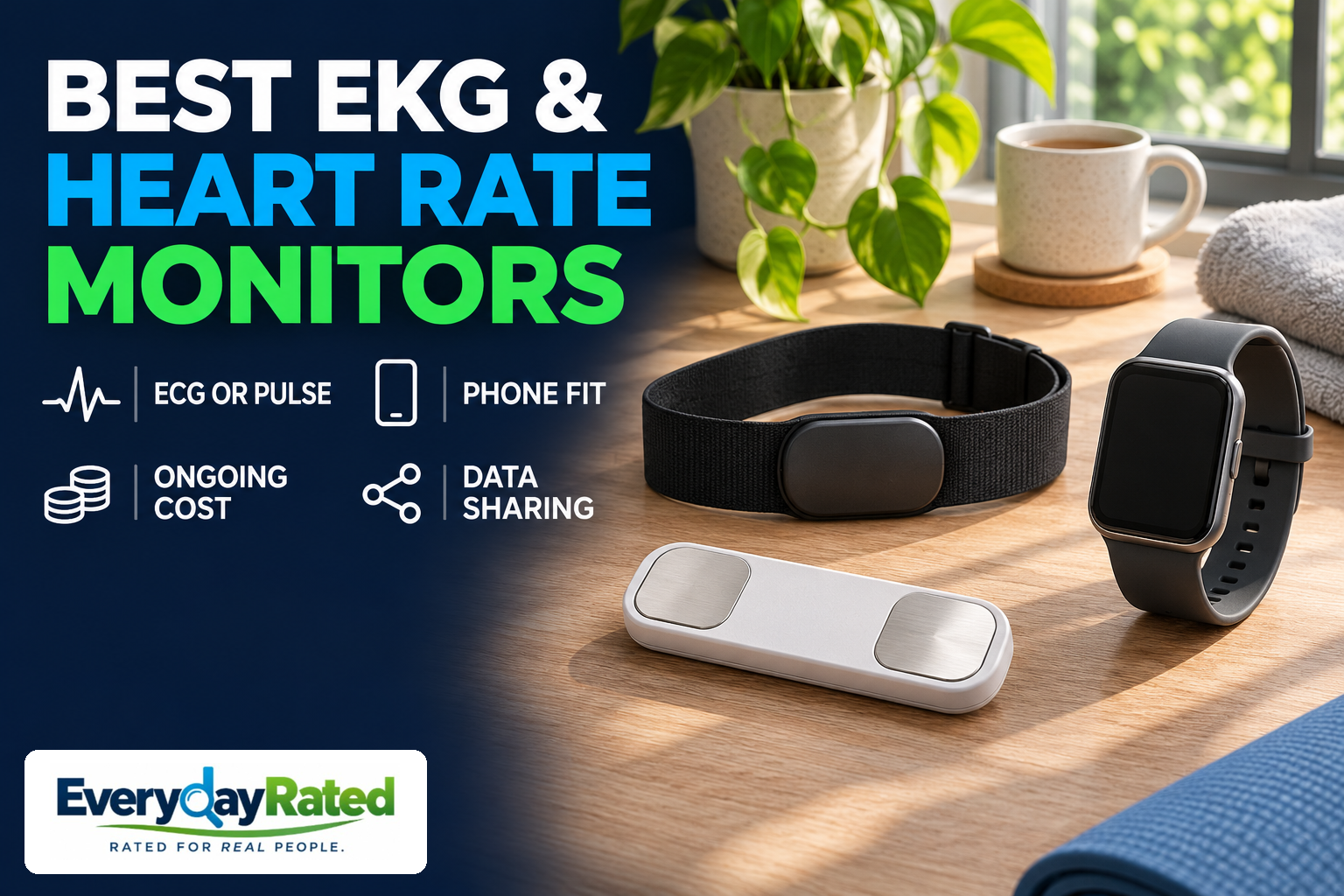
The best EKG and heart rate monitors answer different questions. KardiaMobile is our Best Overall choice for a simple home ECG. Polar H10 is our workout heart-rate pick, while Apple Watch Series 12 suits eligible iPhone owners who also want a smartwatch.
An ECG, also called an EKG, records electrical signals; a heart-rate reading tells you how fast your heart is beating. Those are related measurements, but they are not interchangeable shopping categories. This U.S. buying guide compares three distinct tools and explains when each makes sense. [9]
Affiliate disclosure: EverydayRated may earn a commission from qualifying purchases, at no additional cost to you. Our recommendations are based on independent research and product specifications. Affiliate relationships do not determine our rankings.
Quick Answer: Choose the Job First
For a short ECG record to discuss with your clinician, start with KardiaMobile. For live exercise heart rate, choose Polar H10. For a smartwatch with on-demand ECG and a compatible iPhone, consider Apple Watch Series 12. None replaces prescribed monitoring or emergency care.
KardiaMobile
4.3 / 5
Adults seeking a straightforward spot ECG to discuss with a clinician
$79 listed
Polar H10
4.4 / 5
Exercisers pairing heart-rate data with a compatible watch, phone or fitness device
$89.21 listed; direct checkout maintenance notice
Apple Watch Series 12
4.1 / 5
Eligible iPhone owners wanting everyday smartwatch features alongside spot ECG
From $399 U.S. for 42mm aluminum GPS
How We Evaluated
Last Reviewed: November 13, 2026. This is a research-based comparison, not EverydayRated hands-on testing. We reviewed exact-model documentation, U.S. stores, published research and competing options. We prioritize fit for the intended task over the number of health features on the box.
Our consistent editorial rubric weighs task-appropriate evidence (35%), usability and compatibility (25%), ownership cost and value (25%), and support and maintenance (15%). Scores are rounded editorial judgments, not measured accuracy percentages or proof of health benefit. We did not obtain comparable long-term failure-rate data for all three.
KardiaMobile 6L Max was considered for a clinician who wants additional limb-lead views, but its required membership makes it a different ownership decision. An existing ECG-capable watch may also remove the need for a new one. These alternatives are context, not additional rated recommendations. [14]
At a Glance
| Buying factor | KardiaMobile | Polar H10 | Apple Watch Series 12 |
|---|---|---|---|
| Primary job | Spot ECG | Exercise heart rate | Smartwatch + spot ECG |
| ECG report | Single lead | Not its standard training output | Single lead |
| Use pattern | Deliberate 30-second session | During training | Everyday wear; deliberate ECG |
| Connection | Compatible phone + app | Bluetooth / ANT+ receiver | Supported iPhone |
| Basic recurring fee | No required membership | No required sensor subscription | No required ECG subscription |
| Power / upkeep | Follow device manual | CR2025; washable strap | Regular recharging |
| Checked U.S. listing | $79 | $89.21; checkout notice | From $399 |
| Editorial score | 4.3 / 5 | 4.4 / 5 | 4.1 / 5 |
Prices are checked listing snapshots before taxes and shipping, not guaranteed checkout totals. Polar’s shop-maintenance notice and the REI stock cue mean immediate H10 fulfillment is uncertain. Scores describe usefulness for different tasks, not a head-to-head medical accuracy ranking. [1] [4] [8] [10] [15]
1. AliveCor KardiaMobile — single-lead
EverydayRated Score: 4.3 / 5
KardiaMobile is our starting point when the shopping question is specifically, “How can I record a short ECG at home?” Its narrow job is a strength: you are buying a recording tool rather than a wrist computer. That makes the purchase easier to justify for someone who already likes their watch, or has no interest in charging another wearable every day.
The current single-lead model is listed at $79. It records Lead I in 30 seconds using finger contact and a compatible phone. Basic operation does not require membership, and recordings can be downloaded and emailed. AliveCor describes FDA-cleared classification for AFib, bradycardia, tachycardia and normal sinus rhythm; additional classifications are part of optional KardiaCare. Clearance is specific to its intended function, not a guarantee that every condition will be identified. [1]
Before ordering, check the exact phone against AliveCor’s compatibility information linked from its store. Then ask the intended clinician whether a single-lead tracing answers the question they are investigating and how they want it sent. The useful end product is a record somebody can interpret in context. A growing folder of unexplained alerts is a poor substitute for that plan.
Home ECG evidence and limitations
Clinical evidence also needs context. In the VITAL-AF randomized trial, primary-care screening with KardiaMobile in adults aged 65 and older did not significantly increase new AF diagnoses overall at one year: 1.72% versus 1.59% with usual care. That result neither makes a requested symptom recording useless nor supports selling routine screening as a guaranteed health benefit. [11]
This is an on-demand snapshot, not a continuous monitor. AliveCor says it does not check for heart attack and is not tested or recommended for people with pacemakers or implantable defibrillators. Follow its instructions and ask your clinician about those circumstances. Choose the correct manual for the single-lead device; the card and six-lead products have different operating details. [1] [2]
AliveCor’s limited warranty runs for at least one year, subject to country rules and purchase conditions. Buy through an authorized source and retain the receipt. The 4.3/5 score rewards a focused workflow and low basic ownership cost, with deductions for phone dependence, snapshot coverage and the need for qualified interpretation. Skip it if the real goal is live workout heart rate. [3]
Pros
- No membership required for basic use
- Shareable single-lead ECG recordings
- Lower purchase cost than a new smartwatch
Considerations
- Records only when deliberately activated
- Requires a compatible phone
- Not recommended by AliveCor for pacemakers or ICDs
Why We Picked It
A focused home ECG option with a modest entry price and no compulsory membership for basic recording.
2. Polar H10 Heart Rate Sensor
EverydayRated Score: 4.4 / 5
H10 is our strongest fit for the runner or cyclist who wants heart-rate data during a session. It serves a different purpose from the KardiaMobile. Although it senses electrical activity at the chest, its ordinary training workflow is not a consumer diagnostic ECG report. Buy it to support exercise tracking, not to replace a clinician-prescribed rhythm investigation.
There is meaningful exact-model evidence. A 2022 study of 25 recreational participants compared H10-derived measurements with laboratory ECG during rest and incremental cycling. Heart rate and beat intervals agreed closely, while the nonlinear HRV metric DFA a1 showed wider disagreement at higher intensities. Some data were excluded for artifacts. That supports its training role, not a claim of perfect measurement for all people, sports or rhythm disorders. [6]
Polar specifies Bluetooth and ANT+ connectivity, two simultaneous Bluetooth connections, and a replaceable CR2025 battery with up to 400 training hours. Those are useful features if one sensor needs to feed a watch and another display. Confirm what the receiving device actually accepts before purchasing; a wireless protocol name alone does not establish that every metric will appear in every app. [4] [5]
Workout heart rate: fit and ownership
The practical compromise is wearing and maintaining a chest strap. Follow the manual’s contact, fitting, washing and drying instructions, and detach the connector after use as directed. Choose the strap size from a measurement rather than assuming a watch-band size translates. Allow for eventual strap and battery replacement in the ownership budget. A cheap sensor that stays in a drawer is poor value.
Polar’s U.S. page showed $89.21 for black, but also a shop-maintenance notice. REI’s M–XXL listing showed $104.95 and a sold-out cue. Treat the lower direct price as a listing snapshot, not a promise of immediate fulfillment; confirm checkout or wait for stock. The direct Check Price link remains the exact product destination. Polar lists a two-year guarantee with exclusions, including normal wear. [4] [12] [15]
The 4.4/5 score reflects strong task-specific evidence, useful connectivity and replaceable power. It sits above KardiaMobile numerically because each is assessed for its intended job; the order is not a diagnostic-accuracy contest. H10 loses points for the strap-care burden and current purchase friction. Skip it if you want discreet all-day wear or an ECG tracing for a medical discussion.
Pros
- Published exact-model comparison with ECG
- Dual Bluetooth plus ANT+ connectivity
- User-replaceable battery
Considerations
- Chest fit and strap care matter
- Training data is not a diagnostic ECG report
- Immediate stock and checkout need confirmation
Why We Picked It
The clearest evidence-backed fit here for dedicated exercise heart-rate tracking, with broad training-device connectivity.
3. Apple Watch Series 12 — 42mm aluminum GPS
EverydayRated Score: 4.1 / 5
Series 12 is the choice for someone who wants the watch anyway. Notifications, activity tracking and a wrist display can make the extra cost worthwhile, while the ECG tool adds a separate way to capture a short record. It is harder to justify buying an entire smartwatch when a simple home ECG is the only feature you expect to use.
The current U.S. starting price is $399 for the 42mm aluminum GPS configuration. Series 12 has both electrical and optical heart sensors; Apple specifies up to 24 hours of normal use. Current specifications require iPhone 11 or later, including iPhone SE second generation or later, with iOS 27 or later. This is not an Android recommendation. [8] [10]
ECG and everyday heart-rate tracking
Separate the two heart features in your expectations. Everyday optical heart-rate collection is not an ECG recording. The ECG app requires deliberate contact with the crown and a 30-second session. Apple restricts its intended use to people aged 22 or older and supported regions. An occasional wrist reading should not be mistaken for uninterrupted electrical rhythm surveillance. [9]
Apple’s newest sensing claims are manufacturer claims. We have not established an independent clinical validation of every Series 12 algorithm or a controlled three-way comparison with these picks. We therefore do not translate more frequent background sampling into a promise of better disease detection. Likewise, future software advertised as coming later is not part of the buying case for features available today. [7]
Think through charging and comfort before the feature list. Decide when the watch can be off your wrist without defeating your intended routine. If you already own an ECG-capable Apple Watch that meets your needs, keeping it may be better value. Someone who only needs a sport sensor should compare the smaller purchase and maintenance commitment of a strap.
Apple’s U.S. limited warranty covers manufacturing defects for one year under its terms; it is not an accidental-damage policy. The 4.1/5 editorial score recognizes convenient everyday integration and two distinct sensing modes, while accounting for price, charging, ecosystem limits and limited exact-generation independent clinical evidence. Choose it for the whole smartwatch package rather than an assurance of medical protection. [13]
Pros
- Spot ECG available at the wrist
- Everyday smartwatch and workout functions
- Separate optical and electrical sensing
Considerations
- Requires a supported iPhone
- ECG has age and regional restrictions
- Costs more and needs regular charging
Why We Picked It
A practical combination for eligible iPhone users who value a smartwatch beyond its ECG feature.
Buyer’s Guide: Four Decisions Before You Buy
1. Decide what you need to capture
Start with the information you need, not a sensor count. A runner choosing effort zones needs a different output from a person asked to record intermittent symptoms. If a clinician has requested monitoring, ask whether a consumer spot ECG is suitable or whether they need a prescribed patch, event monitor or another test. Do not substitute based on convenience alone.
More leads provide different electrical views; they do not automatically make a home device equivalent to a standard clinical 12-lead ECG. A device can collect useful information while still missing events between recordings. Nor does a normal-looking snapshot establish that the heart is healthy at other times. [9]
2. Check phone, fit and recording workflow
Check the precise phone, software version, region and intended user before ordering. Do not assume a device works because the phone can install a similarly named app. For a chest strap, measure the chest and check the receiving watch or fitness equipment. For a watch, consider wrist comfort, readable text and how easily the wearer can start a recording.
Ask a family member buying for someone else to walk through the whole process: begin a session, save the result, find it again and share it. A successful checkout is only the first step. For a broader look at watches, rings and bands, our wearables comparison explains the different everyday roles; verify current model details before buying from older coverage.
3. Budget for ownership and agree on data sharing
Separate the device price from optional analysis, clinician reviews, app upgrades and accessories. KardiaMobile’s basic use does not require membership, but the similarly named 6L Max requires one. Do not transfer subscription assumptions between models. If you choose a paid service, read renewal and cancellation terms at checkout rather than assuming the first year represents the lifetime cost. [1] [14]
Decide who will review recordings and how quickly. A downloadable PDF does not establish that a clinician is watching an inbox continuously. Before sharing sensitive health data, review account security, permissions, cloud storage, export and deletion options in the current app and privacy terms. This guide does not establish comparative privacy protections across these vendors. Keep records you may need before changing services.
4. Plan what you will do with an unexpected result
A useful purchase includes a plan for inconclusive recordings and alerts. Ask a clinician what findings should prompt a routine message, an appointment or urgent help. Avoid repeated self-checking as a substitute for assessment. Neither a workout strap nor a consumer ECG is a reason to change prescribed medicines without medical advice.
The ECG app cannot detect heart attack. If you have chest pain, pressure or symptoms suggesting an emergency, contact emergency services immediately rather than waiting for a device result. A normal classification does not override symptoms. This is buying information, not a diagnosis or an individualized monitoring plan. [9]
Related Wearable Buying Guides
If you want apps and notifications as well as heart features, our smartwatch buying guide for Apple, Android and fitness users provides broader shopping context. Its earlier-generation recommendations should not be read as current Series 12 clinical validation.
For other home-monitoring and everyday wellness topics, browse Health & Well-Being.
EverydayRated Verdict
KardiaMobile wins our Best Overall award for the specific home ECG task: a simple, modestly priced route to a shareable spot recording without mandatory basic membership. Polar H10 is the better tool for dedicated exercise heart-rate data, and Apple Watch Series 12 makes sense when a compatible iPhone owner wants the broader watch experience.
You may not need a new device if an existing monitor already meets your agreed plan, or if the real next step is a clinical assessment. Choose the information you actually need first; then check compatibility, recording workflow and total ownership cost. The right monitor is the one suited to that purpose, with its limitations understood.
Sources & Research
- AliveCor KardiaMobile — U.S. price, recording and membership scope
- AliveCor — exact-device user manuals
- AliveCor — warranty and authorized-seller conditions
- Polar H10 — U.S. product, price and checkout-maintenance notice
- Polar H10 — current user manual, care and connectivity
- Schaffarczyk et al., Sensors (2022) — H10 compared with laboratory ECG
- Apple Watch Series 12 — current U.S. product
- Apple Watch Series 12 — technical specifications and phone compatibility
- Apple — ECG setup, interpretation and limitations
- Apple — Series 12 launch, U.S. starting price and availability
- VITAL-AF investigators — randomized screening trial, Circulation (2022)
- Polar — limited international guarantee and exclusions
- Apple — U.S. Watch limited warranty
- AliveCor KardiaMobile 6L Max — alternative and required membership
- REI — H10 M–XXL listing and sold-out cue