
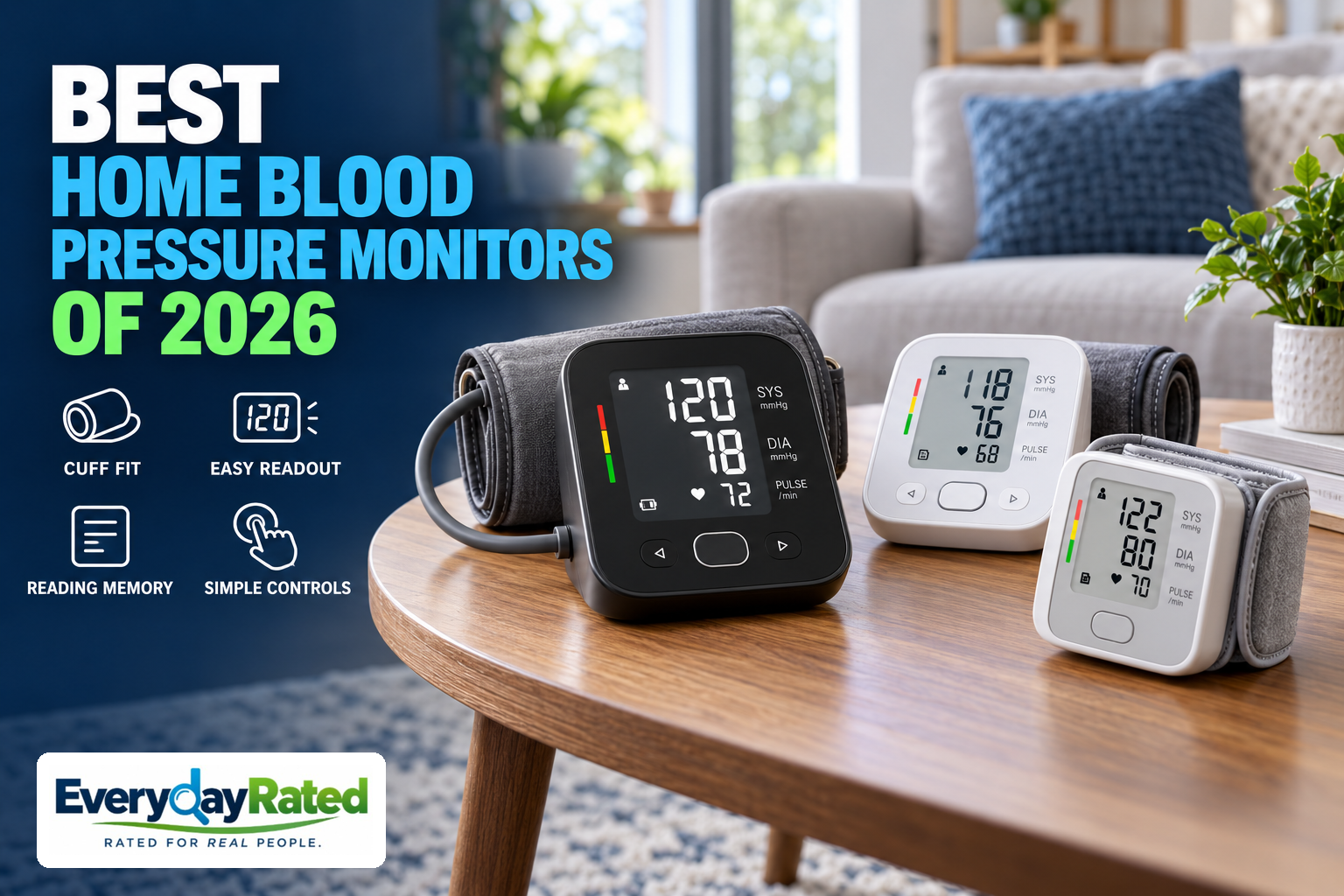
The best home blood-pressure monitor fits your arm, has credible validation and makes consistent records easy. Our Best Overall pick is the OMRON 10 Series BP7465; the lower-cost BP7150 and compact Withings BPM Connect suit different routines.
This U.S. buying guide compares three upper-arm monitors for adult home use. Recommendations reflect research rather than EverydayRated hands-on testing. The most expensive model is not automatically the most accurate.
Quick Answer
Start with cuff fit and exact-model validation, then choose the display and recording method you will actually use.
OMRON 10 Series — BP7465
4.6 / 5
Households wanting readable results and two separate histories
Midrange; check the current offer
Check PriceOMRON 3 Series — BP7150
4.3 / 5
One person wanting a lower-cost validated upper-arm monitor
Budget-oriented; check the current offer
Check PriceWithings BPM Connect — WPM05
4.4 / 5
People who prefer a compact cuff and automatic Wi-Fi records
Midrange; check the current offer
Check PriceHow We Evaluated
Last Reviewed: October 2026. Exact-model ValidateBP listings were an eligibility requirement. We assessed a consistent editorial rubric: display and cuff usability (30%), recording workflow (25%), value and operating costs (25%), and practical ownership, power and warranty provisions (20%). Scores are informed editorial judgments, not clinical test results or calculated failure probabilities.
We cross-checked manufacturer specifications against validation listings and seller pages. We did not assign comparative accuracy scores from marketing language, customer stars or advertised pressure-sensor tolerances. No standardized independent head-to-head study of these three current models was established, and comparative long-term failure rates remain uncertain.
We considered the wider OMRON lineup, including Evolv and Platinum, and Withings BPM Vision. The three picks cover a shared home station, lower-cost single-user use and compact Wi-Fi tracking without making ECG or other extra functions a requirement. Exact model numbers matter: historical BP5450 and BP5100 advice is not interchangeable with newer models.
Prices are page snapshots, before tax, not guaranteed market-wide ranges. Shipping and local stock can change. Regulatory clearance and clinical validation are different evidence questions; neither replaces correct technique or individual suitability.
[1] [2] [3] [4] [5] [6]At-a-Glance Comparison
| Model / Award | Score | Checked Price | Cuff / Records | Main Tradeoff |
|---|---|---|---|---|
| OMRON 10 Series — BP7465 Best Overall | 4.6/5 | Midrange; check the current offer | 22–42 cm cuff; 2 × 100 readings; Bluetooth; backlit dual display; AA or included AC adapter | Larger desktop device; no Wi-Fi |
| OMRON 3 Series — BP7150 Best Value | 4.3/5 | Budget-oriented; check the current offer | 22–42 cm D-ring cuff; 14 readings; Bluetooth; 4 AA batteries purchased separately | Small local history; no on-device timestamps |
| Withings BPM Connect — WPM05 Best for Wi-Fi Tracking and Travel | 4.4/5 | Midrange; check the current offer | Integrated 22–42 cm cuff; Wi-Fi and Bluetooth; rechargeable; compact LED display | Smaller readout; cloud/app setup |
OMRON 10 Series — BP7465
EverydayRated Score: 4.6 / 5
Key Specifications: 22–42 cm cuff; 2 × 100 readings; Bluetooth; backlit dual display; AA or included AC adapter
The BP7465 is our Best Overall choice for a home station where clear results and dependable recordkeeping matter more than minimum size. The strongest reason to pay extra is the complete daily workflow: put on the cuff, review a readable display, and keep each person’s measurements in a separate history. Our award is an editorial assessment of those conveniences, not proof that it measures blood pressure more accurately than the cheaper validated pick.
OMRON specifies a pre-formed 9–17-inch cuff, two users with 100 stored readings each, a dual backlit display, Bluetooth and TruRead averaging. Four AA batteries and an AC adapter are included. Best Buy lists the exact BP7465 with an Add to cart option; current price and delivery depend on the selected offer and location. [1] [7]
The exact model appears on ValidateBP with a 22–42 cm cuff and an ANSI/AAMI/ISO validation protocol. That is the evidence threshold behind its inclusion. It does not establish that every reading will match a clinician’s measurement or that this device suits every medical circumstance. There is no comparable head-to-head clinical dataset here that justifies an accuracy league table among our three recommendations. [4]
For a shared household, the two-user arrangement is useful only if each person selects the correct profile. Decide who uses each slot before starting, and keep guest measurements out of the regular histories. A well-organized record is more valuable than a long list containing mixed users. If you know that profile selection will be forgotten, separate inexpensive monitors may be a more practical arrangement.
The display and cuff design make this the model we would first consider for a reader prioritizing visibility and setup. That remains a buying judgment, not a hands-on comfort finding. If hand strength or vision makes self-use difficult, try a similar cuff and display before ordering. A product photograph cannot tell you whether you can position and fasten it comfortably without help.
AFib screening is an additional feature, not the reason to treat this monitor as a diagnostic instrument. Follow the manual’s instructions about screening results and medical review. A negative screen should not be used to dismiss symptoms. Likewise, an alert is a reason to seek appropriate assessment rather than start or alter treatment yourself. [10]
OMRON lists five-year limited monitor coverage and one-year cuff coverage, with authorized-seller conditions. That policy is useful ownership information, but it is not measured evidence of a five-year service life. Keep the receipt and confirm replacement cuff compatibility. Buy this model if the easier home workflow earns the premium; choose BP7150 if all you need is one person’s measurement plus a written log. [1]
Pros
- Two user histories and substantial local storage
- Backlit display and pre-formed cuff
- AC adapter included
Considerations
- Higher upfront cost than the value pick
- Separate cuff and tubing take storage space
- AFib screening is not a diagnosis
Why We Picked It
4.6/5 reflects strong home usability, useful local records and an included power adapter. Price, bulk and screening limitations keep it below a perfect score.
OMRON 3 Series — BP7150
EverydayRated Score: 4.3 / 5
Key Specifications: 22–42 cm D-ring cuff; 14 readings; Bluetooth; 4 AA batteries purchased separately
BP7150 is our value recommendation for someone who needs an appropriate upper-arm device without paying for a larger display and extensive local records. It is especially sensible when the buyer is comfortable writing measurements in a dated notebook. The savings should support a usable monitoring routine, rather than tempt you to ignore a cuff-size mismatch.
Target lists this exact 3 Series model with an In Stock notice; check its current offer. The manufacturer specifies a 9–17-inch D-ring cuff, one user, 14 stored readings, Bluetooth and one-touch operation. Four AA batteries are required and not included. An AC adapter is also not included. [2] [8]
ValidateBP lists BP7150 with a 22–42 cm cuff under an ANSI/AAMI/ISO protocol. This is why it makes the shortlist ahead of an inexpensive unverified device. The value award does not assume a lower price means weaker measurement quality. It recognizes that a simpler product can meet the evidence threshold while giving up conveniences. [5]
Fourteen stored readings is a modest history. If your clinician asks for several days of morning and evening measurements, plan to transfer or write down results regularly. Date and time appear in the app rather than on the monitor display, according to OMRON. Someone who wants to take the device to appointments with a clearly dated history may find the 10 Series easier. [2]
Bluetooth is available if you prefer digital records, but the purchase decision need not depend on enjoying an app. Work out how you will present readings at appointments before choosing. A legible paper record can be more useful than an app history you cannot find or share. For a caregiver helping remotely, test the reporting process early rather than waiting until the next consultation.
The soft D-ring cuff has a different handling experience from the pre-formed cuff on our overall pick. We have not physically compared comfort or one-handed application. Check whether you can pull the cuff through its ring and secure it without assistance. If that is the recurring obstacle, spending more on a manageable cuff can be worthwhile even when both models are validated.
OMRON’s current page gives the monitor a two-year limited warranty and the cuff one year. Target’s specification panel states one year, so confirm the applicable manufacturer terms and seller eligibility; the article follows OMRON’s current model-specific policy. Add batteries to the initial budget. Choose BP7150 for a single user who accepts modest memory, and move up when display readability or shared use solves a concrete problem. [2] [8]
Pros
- Lowest checked purchase price
- Exact-model validation listing
- One-touch operation with optional app tracking
Considerations
- Only 14 readings in local memory
- One user; no backlit dual display
- Batteries and AC adapter not included
Why We Picked It
4.3/5 rewards validated measurement access and low purchase cost. Limited records and a simpler display constrain convenience, not demonstrated clinical accuracy.
Withings BPM Connect — WPM05
EverydayRated Score: 4.4 / 5
Key Specifications: Integrated 22–42 cm cuff; Wi-Fi and Bluetooth; rechargeable; compact LED display
BPM Connect is the specialist choice for a buyer who values compact storage and digital tracking. Its integrated design removes the separate desktop box from the packing decision. We would choose it for someone who already wants an app-based history, rather than assume every user should move a simple medical routine into a connected ecosystem.
The checked U.S. Withings store shows In Stock and Add to cart; check the current offer. It specifies Wi-Fi and Bluetooth, a 22–42 cm integrated cuff and a rechargeable battery advertised to last up to six months. Actual charging intervals depend on use. The store lists a two-year quality guarantee. [3]
ValidateBP identifies the exact WPM05 device and its 22–42 cm cuff. The listing includes general adults and pregnancy, but buyers should still confirm suitability with their clinician for their own circumstances. Validation is more consequential to this recommendation than the sleek packaging or color-coded result indicator. [6]
Wi-Fi can make sense if remembering to transfer readings is the weak point in your routine. The convenience is record handling, not more accurate measurement. Before buying, decide which phone will manage setup, how you will find historical results and how you will share them. If another person helps you, agree on those steps so useful data does not become trapped in an unfamiliar account.
The compact LED readout is the main ergonomic tradeoff. A cuff-mounted display can be less convenient than a large unit resting on a table, particularly if you prefer to read results without moving your arm. We have not measured readability or tested travel durability. Treat the specialist award as a design-based recommendation and compare the display with your actual needs.
Withings+ is optional; the product page says subscription offers are not mandatory to use the device. Check the cart for any selected trial and its renewal terms. Do not pay for coaching features simply to buy a blood-pressure monitor. The practical question is whether free records and sharing meet your needs, and whether you are comfortable with an account-based health-data service. [3]
The integrated cuff also means fit deserves attention before purchase. Someone outside its supported range needs another suitable device and cuff combination, not a tighter wrap. For travel, bring the charging cable and allow a quiet seated measurement period. Portability is useful when it helps maintain a routine; taking a reading while rushing through an airport undermines that purpose.
Pros
- Compact integrated monitor and cuff
- Wi-Fi syncing rather than Bluetooth alone
- Rechargeable battery
Considerations
- Less display space than a tabletop monitor
- Account and connection setup for digital history
- Integrated cuff has a fixed supported size range
Why We Picked It
4.4/5 reflects a useful compact design and Wi-Fi convenience. Display size, setup dependence and cost limit its general-purpose appeal.
Buyer’s Guide: What Matters Before You Buy
1. Check the exact model and measure your arm
Brand recognition is not enough. Match the model number on the listing, box and validation record. A familiar family name may cover devices with different controls, memory or validation evidence. Keep the instruction manual for the model you actually receive.
All three recommendations list a 22–42 cm cuff range. Measure upper-arm circumference before ordering. The AHA’s cuff-sizing coverage highlights that standard home cuffs do not fit everyone. If your measurement falls outside the range, ask about a validated combination with the right cuff; do not assume a generic replacement is compatible.
[13]Pregnancy, children and particular rhythm disorders need additional suitability checks. This guide does not recommend a single device for every population. Validation listings describe supported populations, while your clinician can help resolve your individual requirements. Fit is the first purchasing decision; an excellent app cannot repair the wrong cuff size.
2. Pay for a routine you can maintain
Think through the measurement from start to finish. Can you put the cuff on alone? Can you read the display? Will another person share the device? Where will you record results? The answers may make a pre-formed cuff, backlight or second user slot worth more than a large list of optional features.
For one person with a notebook, BP7150 is a sensible starting point. For a shared station, BP7465 offers more local organization. For a buyer who already wants a connected history, BPM Connect offers Wi-Fi. These are different workflows rather than levels of medical seriousness.
Avoid purchasing a feature you will not use. If your current validated device fits correctly and you can maintain clear records, a newer app or more attractive display may not justify replacement. If setup is preventing regular use, however, an easier interface can earn its cost.
3. Separate useful records from extra connectivity
Decide how results will reach the person helping manage your care. An app graph is convenient only if you can retrieve it and provide the information needed. Practice exporting, sharing or reading your log before an appointment. For shared devices, maintain clear user separation.
Review account requirements, current phone compatibility, permissions and deletion options before relying on cloud storage. Use the least complicated recording method that meets your needs. Keep an alternate log if phone or connection problems interrupt syncing; do not let a technical inconvenience erase a useful routine.
Compare the total cost: batteries, optional adapters, replacement cuffs and any subscription you elect to buy. A longer warranty is coverage, not evidence of fewer failures. Save purchase details and buy through a reputable seller so model identification and support remain straightforward.
4. Know what accuracy claims and alerts can tell you
A validation listing establishes protocol-based evidence. It is not a promise that every measurement on every person has a fixed error margin. Pressure-sensor tolerances and display resolution are also different from real-world clinical accuracy. We found no basis to declare the premium pick clinically superior to the value pick.
Screening indicators need appropriate follow-up. An irregular-heartbeat symbol and an AFib screen are not interchangeable with a clinician’s diagnosis. Consider whether an added alert helps your care plan before paying for it. Ask for advice if the manual’s restrictions or your medical circumstances make suitability unclear.
The FDA warns against unauthorized devices, including wearable software claiming to measure blood pressure. Authorization must be checked for the exact feature; a smartwatch’s other cleared functions do not automatically establish blood-pressure measurement suitability.
[12]Build a consistent measurement routine
The AHA advises avoiding smoking, caffeine and exercise for 30 minutes beforehand, emptying your bladder, resting quietly for at least five minutes, and measuring on a bare arm with your arm supported at heart level. Take two readings a minute apart and keep the results. Bring the monitor to an appointment to check technique and agreement with office equipment.
Home monitoring supports care; do not change prescribed medication on your own. If systolic pressure is above 180 or diastolic above 120, repeat after at least a minute and contact a clinician immediately if still very high. With symptoms such as chest pain, breathlessness, weakness, vision change or speech difficulty, call 911 without waiting for it to fall.
[9]For broader fitness tracking, see EverydayRated’s best smartwatches of 2026. Choose blood-pressure equipment around validated measurement and cuff fit rather than assuming a fitness wearable serves the same purpose.
EverydayRated Verdict
OMRON 10 Series BP7465 is our Best Overall home blood-pressure monitor because its display, local records and two-user workflow make a complete home station. Choose BP7150 for lower-cost single-user monitoring, and Withings BPM Connect when compact storage and Wi-Fi records justify the premium.
Withings’ higher score than the value pick reflects recording convenience, while BP7150’s award recognizes affordability. None earns a superior-accuracy claim from its price. Keep a suitable validated monitor you already own; confirm arm fit and clinical suitability before replacing it. The best purchase is the device you can position correctly, read comfortably and use with a clear record.
Sources & Research
Accessed October 6, 2026. Exact-model validation listings establish eligibility; manufacturers supply specifications and coverage; stores supply dated prices. Ratings remain editorial assessments.
- OMRON BP7465 — specifications and warranty
- OMRON BP7150 — specifications and warranty
- Withings BPM Connect — U.S. store and specifications
- ValidateBP — exact BP7465 listing
- ValidateBP — exact BP7150 listing
- ValidateBP — Withings BPM Connect WPM05
- Best Buy — BP7465 purchase listing
- Target — BP7150 purchase listing
- American Heart Association — home monitoring instructions
- OMRON BP7465 — instruction manual
- OMRON BP7150 — instruction manual
- FDA — unauthorized blood-pressure devices safety communication
- American Heart Association — cuff sizing research context
- FDA — medical device recall database