
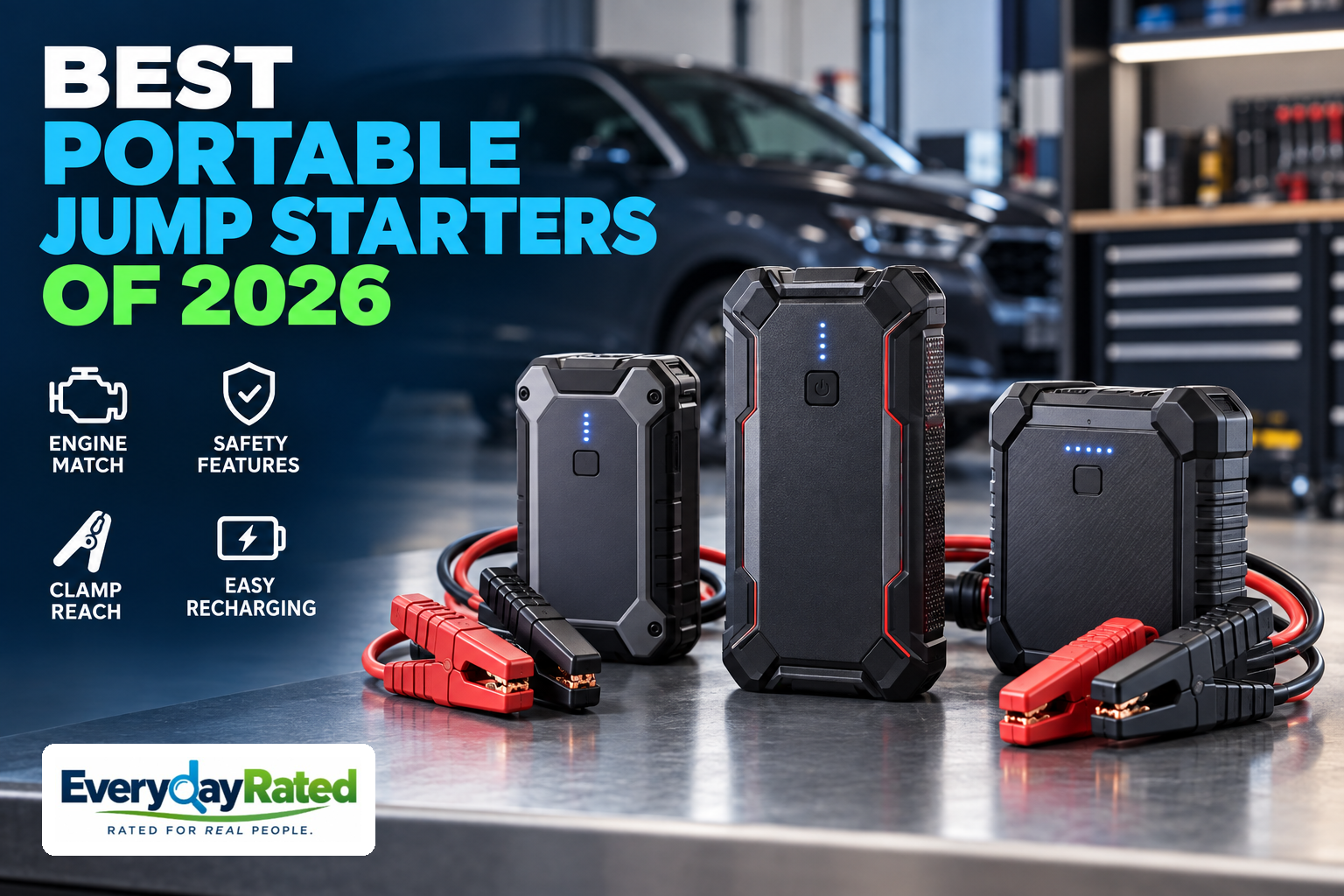
A portable jump starter can help restart a vehicle with a discharged 12V battery without finding a second car. Our Best Overall choice for 2026 is the NOCO Boost X GBX45. Choose the NOCO Boost Plus GB40 to spend less, or the Clore Automotive Jump-N-Carry JNC325 when larger-engine compatibility and cable reach matter more.
This guide focuses on personal emergency packs, with clear distinctions between manufacturer ratings, published testing and our editorial judgment. The best purchase is a charged pack that fits your vehicle and is easy to connect. No pack repairs a failed battery, faulty starter or charging-system problem.
Quick Answer
NOCO Boost X GBX45
4.6 / 5
Drivers of compatible cars, crossovers and smaller trucks who want convenient fast charging.
Check PriceNOCO Boost Plus GB40
4.2 / 5
Owners of compatible smaller vehicles who want to spend less and recharge at home.
Check PriceClore Automotive Jump-N-Carry JNC325
4.5 / 5
Drivers needing more cable reach and a pack specified for up to 8.0L gas or 6.0L diesel engines.
Check PriceHow We Evaluated
Last Reviewed: October 2026. We compared current U.S. listings, manufacturer specifications and original testing from WIRED and Car and Driver. EverydayRated did not physically test these packs. Scores are research-based editorial judgments, not laboratory measurements or retailer star ratings.
Our rubric weighs vehicle suitability and starting evidence (35%), safe operation and connection usability (25%), portability and recharging (20%), and price, documentation and warranty support (20%). No comparable long-term failure-rate data were established. The score explanations below identify the main strengths and deductions; we do not claim numerical precision beyond an editorial comparison.
We also reviewed competing approaches including higher-output GOOLOO packs, the WOLFBOX 4000A, and larger shop-style units. Their existence does not establish that more peak amps make a better personal emergency kit. Independent tests differ in vehicles, battery condition and temperature, so their jump counts cannot be compared as a common laboratory ranking.
At-a-Glance Comparison
| Product / award | Engine ceiling* | Charging / reserve | Price checked | Key tradeoff |
|---|---|---|---|---|
| GBX45 · Best Overall · 4.6/5 | 6.5L gas / 4.0L diesel | 60W USB-C PD · 31 Wh | Midrange | Compact, limited reserve |
| GB40 · Best Value · 4.2/5 | 6.0L gas / 3.0L diesel | Current USB-C 5V/2.1A · 24 Wh | Lower midrange | Slower charging; verify revision |
| JNC325 · Larger Engines & Reach · 4.5/5 | 8.0L gas / 6.0L diesel | 74 Wh · verify charge configuration | Premium | More cost and bulk; 24-inch cables |
*Manufacturer or seller suitability ratings, not guaranteed performance in every climate. U.S. listing prices checked October 6, 2026; discounts, stock and shipping can change.
[1] [2] [4] [5] [6] [7]1. NOCO Boost X GBX45
EverydayRated score: 4.6 / 5
Key Specifications: 1,250A advertised peak; 6.5L gas / 4.0L diesel ceiling; 31 Wh; 60W USB-C input/output; 100-lumen light; IP65 with ports closed; one-year limited warranty.
[1] [2]The GBX45 offers the most useful balance for a personal emergency kit. It is small enough to carry easily, supports fast recharging, and has a documented operating procedure. Its value comes from making the pack convenient to maintain between emergencies, rather than from having the largest number printed on its enclosure.
WIRED’s hands-on reviewer found it effective on four- and six-cylinder vehicles but noted limited reserve and awkward clamp access on some cars. That supports choosing it for occasional personal use, rather than assuming it can repeatedly revive a fleet of neglected vehicles.
[8]The main purchasing question is whether faster charging matters to you. If you already have a suitable USB-C PD charger, replenishing this pack can fit naturally into your routine. If you need to buy one, include that cost. Its USB power-bank function is useful away from home, but keep enough charge reserved for the job that justified buying it.
Before ordering, locate your vehicle’s approved jump points and judge whether the clamps can reach and grip them. A convenient pack that cannot connect properly is a poor match. For a large diesel, move to an appropriately rated larger unit instead of interpreting “truck compatible” as universal coverage.
The score reflects strong everyday usability and charging convenience, with deductions for modest energy reserve and restricted clamp access. The engine ceiling is a manufacturer rating, not a promise for every engine at every temperature.
Pros
- Fast USB-C PD recharging reduces maintenance friction.
- Compact format suits an occasional roadside kit.
- Documented controls and separate work light.
Considerations
- Small energy reserve limits repeated demanding starts.
- Clamp size and reach can be awkward on some vehicles.
- Suitable fast charger is an additional purchase if you lack one.
2. NOCO Boost Plus GB40
EverydayRated score: 4.2 / 5
Key Specifications: 1,000A advertised peak; 6.0L gas / 3.0L diesel ceiling; current specification lists 24 Wh and USB-C input up to 5V/2.1A; USB device output; 100-lumen light; one-year limited warranty.
[4] [5]The GB40 is the sensible lower-cost choice when basic emergency starting matters more than charging speed. It occupies a lower price tier than the GBX45; compare the current offers. That is a meaningful saving for a pack that will spend most of its time waiting in a storage bag, provided your vehicle falls comfortably within its supported range.
Check the charging revision before buying. NOCO’s current page lists USB-C input and a 24 Wh battery. Older GB40 reviews describe a different Micro-USB configuration. Ask the seller which version ships; older inventory should not be assumed to match the current specification. USB-C alone also does not mean 60W PD charging.
[4] [5]Car and Driver’s tested older GB40 restarted its vehicle but had limited reserve and awkward leads. That finding is relevant background, not a controlled performance test of the currently listed revision.
[9]For a household with a modest gasoline car and a regular charging routine, the GB40 can be enough. For someone helping several vehicles, operating near the engine-size ceiling, or relying on rapid turnaround after use, the GBX45 or a higher-capacity alternative is the more useful purchase.
Value here means paying for a focused tool with clear documentation. It does not mean this is the cheapest jump pack on the market. Check connector type, included cable, seller return policy and vehicle compatibility before comparing the price with an anonymous pack that advertises several times the peak current.
The score rewards affordability and straightforward use, while deducting for slower charging and uncertainty when applying older testing to current stock. A working GB40 already in your kit does not need replacement simply because the connector on new inventory changed.
Pros
- Lower checked price than the overall winner.
- Focused feature set for an occasional emergency.
- Current manufacturer page provides clear compatibility limits.
Considerations
- Current USB-C input is substantially slower than GBX45 PD.
- Old and current listings can describe different hardware.
- Not our pick for repeated starts or larger diesel engines.
3. Clore Automotive Jump-N-Carry JNC325
EverydayRated score: 4.5 / 5
Key Specifications: 450 Start Assist Amps; 74 Wh; 24-inch #6 AWG cables; two USB outputs; work light; retailer lists 8.0L gas / 6.0L diesel support and a one-year limited warranty.
[6] [7]The JNC325 earns its place by addressing a practical problem that compact packs cannot always solve: reaching the correct connection points. Longer, substantial cables can make a larger difference during a roadside stop than a small display or an extra phone-charging port. Its higher listed engine ceiling also gives larger-vehicle owners a more relevant starting point.
Car and Driver selected the JNC325 as its overall winner. We give it a specialized award because its cost and size make it less compelling for an average commuter than a compact pack that is easy to keep charged.
[9]Clore’s brochure documents a 74 Wh reserve and 24-inch cables. These are useful shopping distinctions; its 450 Start Assist Amp rating should not be directly compared with another brand’s peak-amp claim.
[6]Read the included manual and inspect the charging connector on the unit you receive. The original brochure describes QC3.0 charging and included accessories, while some newer listings describe USB-C. Connector revisions are not a reason to assume identical charge speeds or included wall adapters. Buy the listing that clearly states the configuration you want.
The larger pack is easiest to justify when its reach or compatibility solves a known need. For a small car with accessible terminals, the extra expenditure may add little to a well-maintained compact emergency kit. For a bigger vehicle, measure access first and choose on that requirement rather than brand familiarity alone.
The score reflects reach, documented reserve and relevant independent testing, with deductions for price and carrying convenience. It trails our overall score because this guide prioritizes a personal portable kit, even though it is the better fit for the larger-engine use case.
Pros
- 24-inch cables offer useful connection flexibility.
- Larger documented energy reserve than our compact picks.
- Relevant independent test coverage of the exact model.
Considerations
- Higher purchase cost for occasional small-car use.
- Less convenient to carry than the compact picks.
- Confirm charging revision and included accessories with the seller.
Buyer’s Guide: What Matters Before You Buy
1. Match the vehicle before comparing amp claims
Start with your vehicle manual: battery voltage, chemistry, approved jump points and permitted procedure. These NOCO packs specify 12V lead-acid starting batteries. Do not assume a 12V pack works on a 24V truck system, or that an EV’s traction battery can be jump-started with one. Some hybrids and EVs have a separate low-voltage system; follow that vehicle’s exact instructions.
Engine size is a screening tool, not a complete prediction of starting difficulty. Diesel compression, cold conditions, battery state and connection resistance all affect the job. Avoid shopping right at a listed engine ceiling when conditions are demanding. Peak amps also lack a universal cross-brand comparison method; prioritize compatibility and credible tests.
[2] [5]2. Check cable reach, clamps and override behavior
Find the approved connection points before your first emergency. Check whether clamps can open far enough, reach the designated locations and remain clear of moving parts. A pack that fits in a glovebox is useful only if it can connect without stretching cables or balancing awkwardly under the hood.
Some units refuse to activate when battery voltage is too low to detect normally. NOCO documents a manual override for that situation, but override disables safety protections. Use it only as directed after confirming polarity and connections; it is not a routine starting mode. Follow both manuals, observe crank and cool-down limits, and never attempt to jump a damaged or frozen battery.
[3]3. Buy charging convenience you will actually use
A USB-C connector does not specify charging speed. The GBX45 supports PD fast charging; the current GB40 lists a much slower input. Include the right adapter and cable in the total price, and inspect the seller’s photos and included-items list. A wall charger is not automatically included because the product is rechargeable.
For occasional personal use, the ability to recharge promptly after one emergency is more useful than an optimistic maximum-jumps claim. If you charge phones from the pack on a trip, replenish it before relying on it for starting. For frequent workshop use, a larger unit may suit the job better than any of these compact personal kits.
[2] [5]4. Plan storage, maintenance and the next repair
Charge the pack when it arrives, learn its indicators, and check it before seasonal travel and after every use. Follow the exact manual’s storage temperature and recharge schedule. A hot vehicle interior or prolonged severe cold can fall outside those limits; portability gives you the option to bring the pack indoors.
Inspect cables and clamps and stop using a pack showing swelling, damage or overheating. Keep the receipt and serial number for support. A warranty covers specified defects under its terms; it does not establish the probability that a device will work after years of neglect.
Repeated jump-starts are a reason to investigate the battery and charging system, not a normal maintenance plan. A maintainer can suit a rarely used vehicle with access to power; a jump starter serves a different purpose. If the vehicle still will not start after the prescribed attempts, seek assistance instead of extending cranking indefinitely.
For broader vehicle preparation, see our best all-season tires of 2026 and ice scrapers and snow brushes guide. Match each item to your vehicle and local conditions.
EverydayRated Verdict
NOCO Boost X GBX45 is our Best Overall portable jump starter of 2026 for compatible everyday vehicles. Its charging convenience makes a useful emergency tool easier to maintain. Choose GB40 when lower cost matters more than recharge speed, and confirm the charging revision. Choose JNC325 when its cable reach and larger-engine rating solve a specific need.
You may not need a portable pack if a simpler maintenance plan addresses your actual problem, or if you prefer roadside assistance. If you buy one, the decisive requirement is compatibility with your exact vehicle, followed by a charging and storage routine you can keep.
Sources & Research
Sources accessed October 6, 2026. Manufacturer specifications are stated ratings; published testing applies to the configuration actually tested.
- NOCO GBX45 — U.S. product and price
- NOCO GBX45 — specifications
- NOCO GBX45 — support and manual override
- NOCO GB40 — current U.S. product and price
- NOCO GB40 — current specifications
- Clore JNC325 — original manufacturer brochure
- JB Tools — JNC325 specifications, price and stock
- WIRED — original hands-on jump starter testing
- Car and Driver — original hands-on jump starter testing