
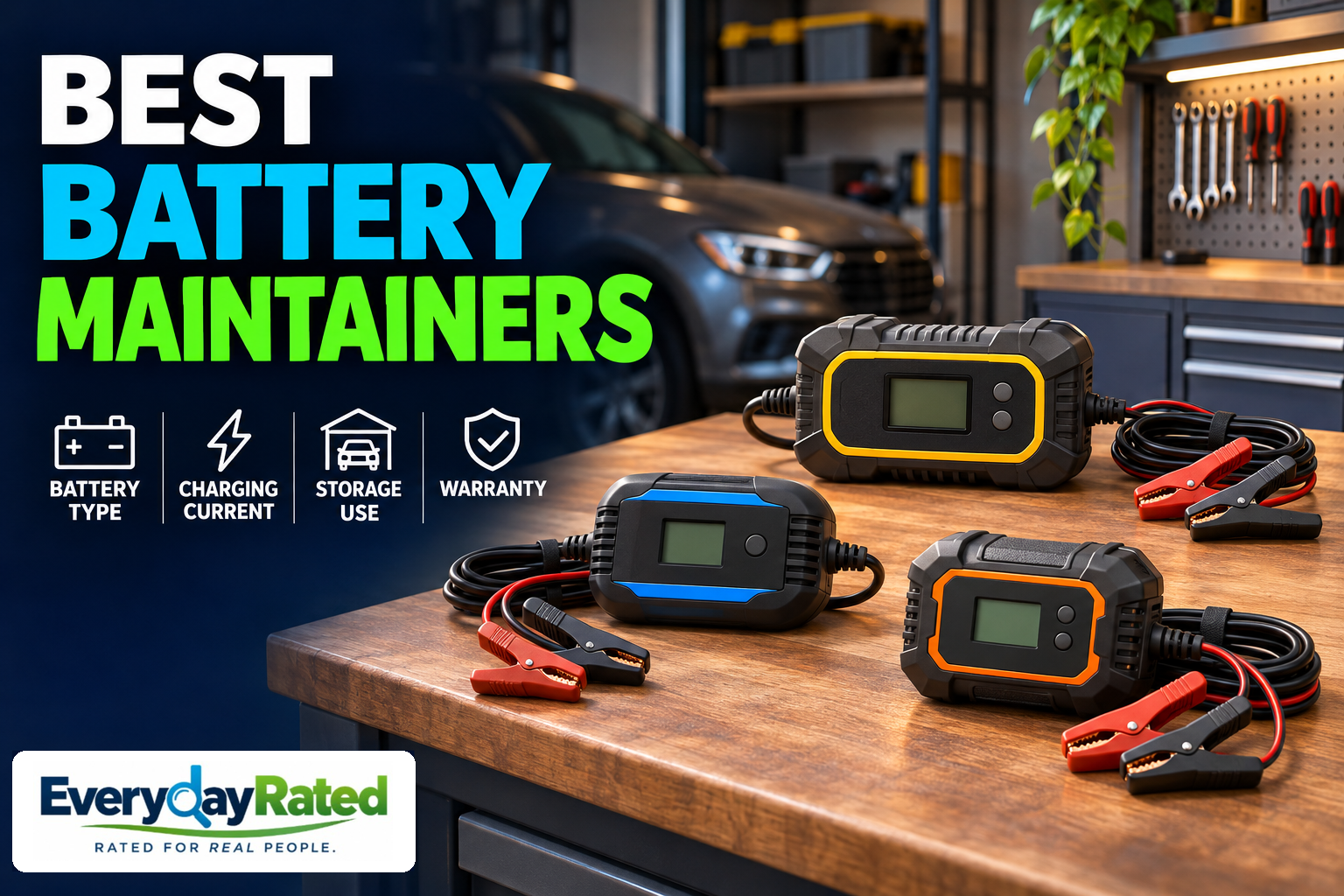
A parked car should not turn its next outing into a battery audition. Our Best Overall battery maintainer for 2026 is the NOCO GENIUS5, because it balances ordinary maintenance with useful recharge capacity. The NOCO GENIUS1 is the low-cost storage pick, while the CTEK MXS 5.0 NA suits specific 12V lead-acid users who value a longer warranty and have a mild-temperature storage space.
This research-based U.S. guide is for occasional-use cars, seasonal vehicles and home garages with AC power. These products need an outlet. They are not portable jump starters, and no charger can promise that an old or damaged battery will become dependable again.
Affiliate disclosure: EverydayRated may earn a commission from qualifying purchases, at no additional cost to you. Our recommendations are based on independent research and product specifications. Affiliate relationships do not determine our rankings.
Quick Answer: Which Battery Maintainer Should You Buy?
Choose GENIUS5 if the same tool needs to maintain and recharge an ordinary car battery. Choose GENIUS1 for economical upkeep of a healthy, already charged battery. MXS 5.0 NA makes sense only when its lead-acid-only compatibility and documented temperature limits fit your storage setup.
NOCO GENIUS5
4.4 / 5
$69.95 listed
Most car owners wanting maintenance plus useful recharge capacity
NOCO GENIUS1
4.1 / 5
$29.95 listed
Maintaining a compatible, healthy battery that is already charged
CTEK MXS 5.0 NA — item 40-206
4.0 / 5
$99 sale / $119.99 reference price listed
12V lead-acid owners prioritizing a longer warranty in a suitable-temperature garage
How We Evaluated
Last Reviewed: November 12, 2026. EverydayRated did not physically test these chargers. These are editorial judgments based on current U.S. documentation, purchase listings, original published observations and battery-care guidance.
We used the same decision factors for every pick: battery and task compatibility (30%), charging/maintenance usefulness and evidence (25%), setup and placement (20%), and price, warranty and ownership constraints (25%). Scores are qualitative assessments out of five, not laboratory readings or a weighted arithmetic simulation. We do not have comparable failure-rate data.
We considered Battery Tender Plus 021-0128, but its direct store showed sold out at the time checked. The $49.95 NOCO GENIUS2 is an intermediate option for buyers who specifically need its smaller charging class. Neither was added merely to lengthen the shortlist. The three picks here serve distinct storage needs, and none earns a universal battery-recovery claim. [14] [15]
At a Glance
| Buying factor | NOCO GENIUS5 | NOCO GENIUS1 | CTEK MXS 5.0 NA |
|---|---|---|---|
| Output | 5A | 1A | 4.3A maximum, NA model |
| Supported scope | 6V lead-acid; supported 12V lead-acid/lithium | 6V lead-acid; supported 12V lead-acid/lithium | 12V lead-acid only |
| Charging capacity guidance | Up to 120Ah | Up to 30Ah | 1.2–110Ah |
| Enclosure / warranty | IP65 / 3 years limited | IP60 / 3 years limited | IP65 / 5 years limited |
| Checked U.S. price | $69.95 | $29.95 | $99 sale; $119.99 reference |
| Most important limitation | Advanced modes need care | Slow for depleted car batteries | NA manual: 41°F minimum operating temperature |
Charging capacity is not the same as maintenance capacity. All prices are checked listing snapshots before tax and shipping; checkout availability and promotions may change. Warranty terms and exclusions apply. [1] [2] [5] [6] [8] [9]
1. NOCO GENIUS5
EverydayRated Score: 4.4 / 5
Key Specifications: 5A; 6V lead-acid / supported 12V lead-acid and lithium; charging up to 120Ah; IP65; three-year limited warranty
GENIUS5 is our most balanced choice for someone buying one charger for an ordinary home garage. At the checked $69.95 direct-store price, it occupies the useful middle ground between inexpensive storage maintenance and a larger workshop charger. Its broader role makes the extra spend over a small maintainer easier to justify if the same car occasionally needs recharging. [1]
NOCO specifies 5A output and charging for batteries up to 120Ah. It supports 6V lead-acid and several 12V lead-acid modes, plus a supported 12V lithium mode. This is battery-label compatibility, not permission to use any setting with any vehicle. The lithium setting requires a battery management system and battery-maker approval. It does not charge an electric vehicle’s high-voltage traction pack. [2] [3]
The integrated temperature compensation and detachable clamp/eyelet arrangement are useful conveniences, especially if a vehicle regularly returns to the same parking spot. IP65 protection is more reassuring than the GENIUS1’s IP60 enclosure for a potentially damp garage. It still needs placement and electrical connections that follow its manual; an enclosure rating does not make the wall outlet or every connection weatherproof. [2] [6]
Usability, evidence and limitations
Its advanced features deserve restraint. Force Mode disables safety features, while the separate high-voltage Repair setting can affect sensitive electronics. Neither setting is a routine storage step, nor evidence that a worn-out battery can be rescued. Have a suspect battery evaluated instead of repeatedly attempting recovery because a charger has a button for it. [3] [4]
There is some independent usability evidence: Oliver Jobson compared the GENIUS5 with a CTEK MXS 5.0, preferring the CTEK for his UK buying situation and the NOCO where 6V or lithium support matters. That is useful context, but his regional prices and CTEK hardware do not establish a North American charging-speed result. Our U.S. recommendation weighs the checked price and documented application fit, rather than importing his winner unchanged. [10]
The 4.4/5 editorial score recognizes broad compatibility, practical charging current and moderate purchase cost. It loses points for the care required around advanced modes and the absence of a controlled, current U.S. three-way test. Buy it if you want a general garage tool; skip it if you only need inexpensive maintenance for an already charged battery.
Pros
- Useful 5A recharge capability alongside maintenance
- Supported 6V lead-acid and 12V lithium options
- IP65 enclosure and three-year limited warranty
Considerations
- Recovery modes require extra care
- No promise of reviving a failed battery
- Not a portable jump starter
Why We Picked It
The broadest balance of price, compatibility and recharge capacity for a one-charger home garage.
2. NOCO GENIUS1
EverydayRated Score: 4.1 / 5
Key Specifications: 1A; 6V lead-acid / supported 12V lead-acid and lithium; charging guidance up to 30Ah; maintenance listed for larger batteries; IP60; three-year limited warranty
GENIUS1 is the sensible budget choice when the job is keeping a parked vehicle ready rather than quickly replenishing a depleted car battery. The checked $29.95 price is less than half that of the GENIUS5. A buyer maintaining one healthy battery may get more value from this modest tool than from paying for charging output they rarely need. [5]
Its most important specification is the distinction between charging and maintenance. NOCO rates normal charging applications up to 30Ah, while listing maintenance for all battery sizes. That does not turn 1A into a practical fast charger for a depleted full-size automotive battery. For a car that is already low, choose suitable recharge capacity first and use the small unit for ongoing maintenance afterward. [6] [7]
The direct-plug body is compact, and the listed output cable is 106 inches long. That arrangement can suit a wall outlet near the parked vehicle, but outlet orientation and the route past doors or tires matter. Walk the intended cable route before buying. A low price is less useful if the unit cannot be placed securely without stretching the cable across a traffic path. [6]
Compatibility and ownership limits
The supported battery modes cover common 12V lead-acid types and compatible 12V lithium batteries with a battery management system, along with 6V lead-acid. Select the mode deliberately. A maintainer is not a universal power adapter, and the existence of a lithium setting does not establish compatibility with a particular replacement battery. [7]
IP60 makes this the sheltered, dry-location choice of the three. The three-year limited warranty is welcome at the price, but warranty length does not establish a failure rate or useful service life. We found no controlled independent exact-model head-to-head that would justify a claim of superior regulation, speed or durability. Its 4.1 score rests mainly on documented functionality and strong fit for a limited task. [6]
Choose it for deliberate storage care with a healthy battery and suitable power nearby. Spend more if frequent recharging is part of your normal routine. If a battery repeatedly goes flat despite correct maintenance, move to diagnosis of the battery, vehicle charging system or unwanted drain rather than simply buying a larger charger. [12]
Pros
- Low checked purchase price
- Compact body and long output lead
- Multiple supported battery modes
Considerations
- 1A output is slow for substantial recharging
- IP60 calls for sheltered placement
- Limited independent exact-model performance evidence
Why We Picked It
It covers the narrower maintenance job at low cost without pretending to be a fast automotive recharge solution.
3. CTEK MXS 5.0 NA — item 40-206
EverydayRated Score: 4.0 / 5
Key Specifications: North American model 1090; 4.3A maximum; 12V lead-acid only; 1.2–110Ah charging; maintenance up to 160Ah per product page; IP65; five-year limited warranty
The North American MXS 5.0 is a specialized alternative for a buyer who knows the vehicle uses a compatible 12V lead-acid battery. CTEK’s direct store showed item 40-206 in stock at $99, against a $119.99 reference price. The longer five-year limited warranty is its clearest ownership advantage here, although coverage length is not a reliability test. [8]
Do not read the model name as the output specification. The current North American manual identifies model 1090 and a maximum current of 4.3A. Its 12V lead-acid scope excludes lithium, and European MXS 5.0 specifications should not be substituted. These regional details matter more than the familiar product name when ordering. [9]
A particularly important limitation is temperature. The linked North American manual gives an operating range starting at 41°F (5°C). That makes this a poor default recommendation for an unheated freezing garage, despite the product page’s broad weather-oriented language. Check the supplied unit’s documentation and choose another product if your storage conditions fall outside its permitted range. [9]
Charging process and ownership value
The documented multistage approach and temperature compensation suit careful planned charging. However, high-voltage reconditioning is not a routine setting for every battery. The manual also says to verify arrival at maintenance Step 7 before leaving the charger connected unattended for long periods. Follow the actual instructions rather than treating automatic charging as an instruction to ignore errors. [9]
Jobson’s comparison supplies useful observations about the CTEK family’s usability, but it is not a controlled test of this current North American configuration. We have therefore not awarded it a charging-speed or battery-restoration win. Nor do we infer improved battery life from the number of stages shown on the case. [10]
Its 4.0 score reflects a longer warranty and a defined lead-acid application, offset by higher price, narrower chemistry support and the stated temperature restriction. Pick it for a mild-temperature storage location and compatible battery. For a cold garage or a mixed collection of batteries, the NOCO options are easier to justify after checking their operating limits.
Pros
- Five-year limited warranty
- Documented lead-acid charging and maintenance process
- IP65 enclosure
Considerations
- No lithium or 6V support
- North American documentation limits cold-location use
- Higher checked price than either NOCO pick
Why We Picked It
A warranty-focused alternative for a compatible 12V lead-acid battery in a location that meets its documented temperature limits.
Buyer’s Guide: Four Decisions Before You Plug In
1. Match the battery, vehicle and charging mode
Read the battery label before shopping: voltage, chemistry and capacity matter. Absorbent glass mat (AGM) is a lead-acid design with its own charging requirements. A lithium replacement battery adds further restrictions. Check both battery and charger instructions; a vehicle name alone is not enough to establish compatibility.
Use the vehicle’s approved charging points and connection procedure, especially when it has a battery-monitoring sensor or remotely located battery. This guide is a purchase comparison, not a substitute for model-specific wiring instructions. If access or battery identification is unclear, ask a qualified technician rather than experimenting. [3] [9]
2. Decide whether you need maintenance or recharging
A storage maintainer offsets loss of charge in an appropriate setup. A depleted battery needs energy put back first. For a simple illustration, replacing 30 amp-hours at a perfectly constant 1A would take 30 hours before any charging losses or taper; at 5A the theoretical minimum would be six hours. Real charging takes longer and varies with condition. This is arithmetic, not a measured time for any recommendation.
That distinction explains why the least expensive unit can be the right buy for one car and frustrating for another. Do not select it solely because its maintenance claim includes large batteries. If repeated low-battery events interrupt normal use, have the battery and vehicle checked instead of assuming more charger output will solve the cause. [11] [12]
3. Plan the outlet, cable route and environment
Start with where the vehicle actually parks. Measure from a suitable outlet to the approved charging points, allowing a route that avoids hot components, sharp edges, pinch points and moving parts. Check approved extension-lead requirements before relying on an extension cord. The convenient setup is the one that can be used correctly every time.
Enclosure protection, ambient operating temperature and safe AC connections are separate questions. Do not use an IP rating as shorthand for outdoor approval. The CTEK North American temperature limit is particularly consequential for winter storage: a product can have temperature compensation while still being unsuitable below its stated operating minimum. [3] [9]
4. Treat recovery claims and ownership costs realistically
Compare the charger, any approved connector accessories, and the cost of a battery inspection when needed. No subscription is needed for these basic chargers. More stages and more recovery language do not demonstrate more years of battery life. Warranty coverage is useful, but shipping arrangements, exclusions and proof-of-purchase requirements still matter.
Never attempt to charge a visibly damaged or frozen battery. Use ventilation and the exact safety procedure supplied with the battery and charger. Advanced high-voltage recovery settings and safety-bypassing modes deserve special caution; they are not ordinary maintenance shortcuts. A battery that will not hold charge may need replacement, not another recovery cycle. [13] [3] [4]
Related Garage & Auto Guides
Battery care is one part of a seasonal vehicle plan. Our guide to ice scrapers and snow brushes for cars and SUVs covers another practical cold-weather preparation task.
If your next decision is tires rather than charging equipment, compare the trade-offs in our all-season tire buying guide. For more maintenance and vehicle equipment, browse Garage & Auto.
EverydayRated Verdict
NOCO GENIUS5 is our Best Overall choice for a typical home garage because its 5A charging class and supported battery options make it useful beyond storage upkeep. GENIUS1 is the better value when you deliberately need only modest maintenance for a healthy, charged battery.
CTEK MXS 5.0 NA is the specialized alternative for compatible 12V lead-acid storage in a space that meets its stated temperature requirements, with a longer limited warranty. It is not our default freezing-garage pick.
You may not need any of these if the vehicle’s battery stays properly charged through normal use and inspection. If the battery repeatedly goes flat, seek a diagnosis first. The final buying decision is simple: match the battery, task and parking conditions before comparing price or recovery buttons.
Sources & Research
- NOCO GENIUS5 — U.S. product and price
- NOCO GENIUS5 — specifications and warranty
- NOCO GENIUS5 — North American user guide
- NOCO GENIUS5 — modes, capacity guidance and support
- NOCO GENIUS1 — U.S. product and price
- NOCO GENIUS1 — specifications and warranty
- NOCO GENIUS1 — operating modes and capacity guidance
- CTEK MXS 5.0 NA, item 40-206 — U.S. specifications, price and availability
- CTEK MXS 5.0 — North American manual, model 1090
- Oliver Jobson — original CTEK/NOCO comparison; UK hardware and pricing context
- Interstate Batteries — charging and maintenance guidance
- Interstate Batteries — battery care and diagnostic FAQs
- Interstate Batteries — safe battery charging, PowerVolt guide
- Battery Tender Plus 021-0128 — alternative considered and direct-store stock status
- NOCO GENIUS2 — intermediate alternative considered